Recall the nature of oscillating systems Simple Harmonic Motion (SHM).
Reflection
Reflection is the inversion of the perpendicular component of an incident wave. For instance, a wave coming in at 60 degrees to the surface only has its vertical component inverted, and maintains its horizontal component.
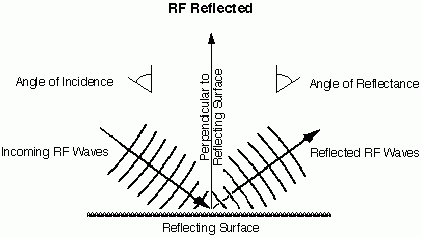
Angle of incidence = Angle of reflection. Reflection of waves from a fixed end is inverted.
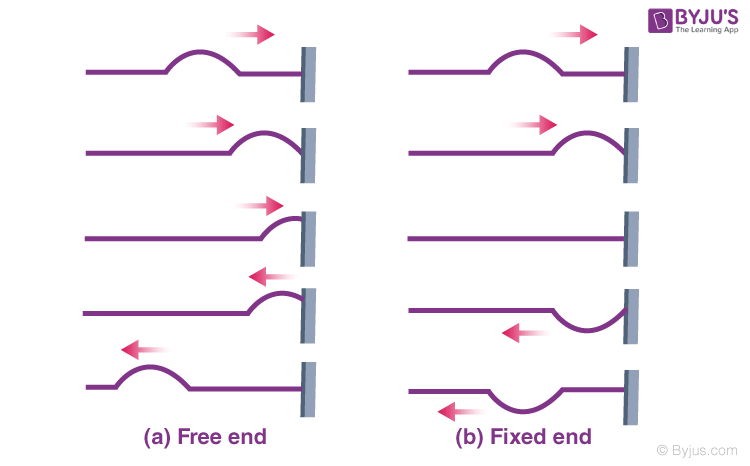
Refraction and Snell’s Law
Refraction is the change in direction of a wave when it transmits from one medium to another.
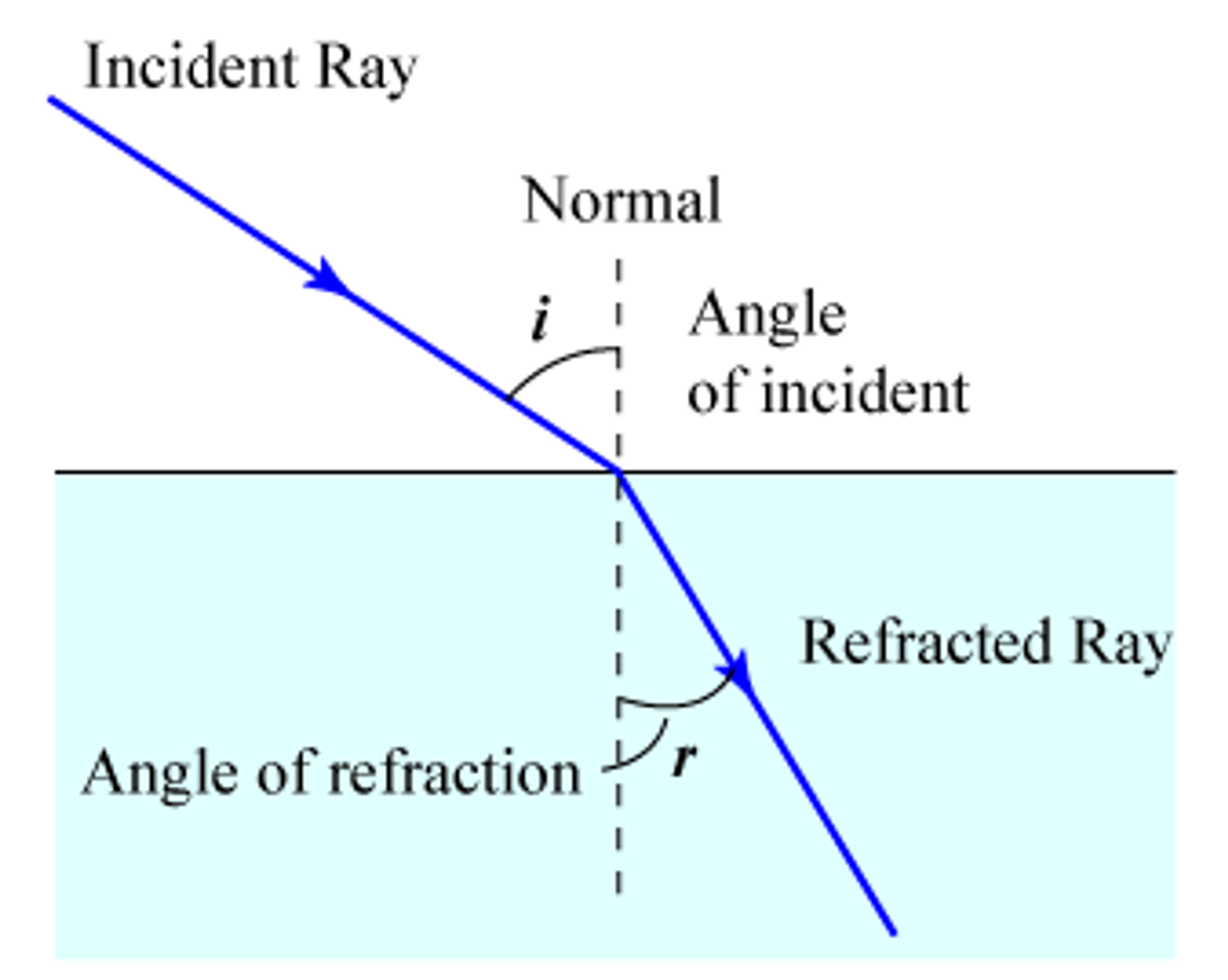 The angle of incidence and the angle of refraction can be determined by Snell’s law given by the following formula (Snell’s Law)
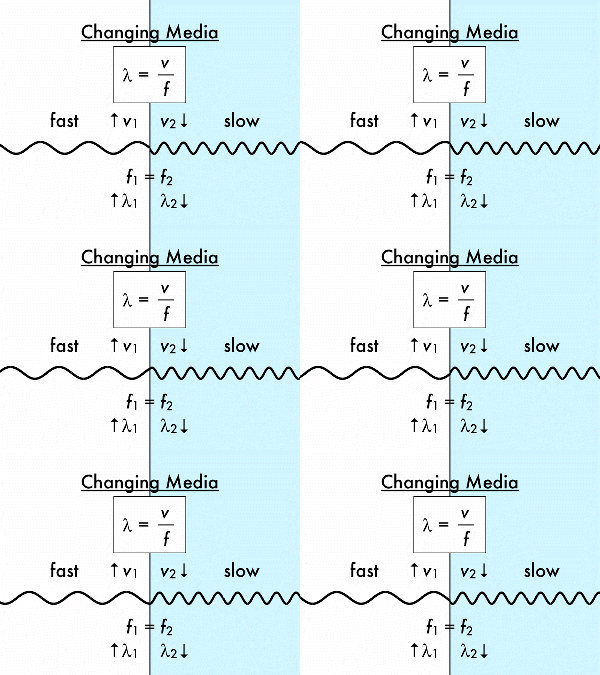
Where and are the speed of the waves in their respective mediums and and are the wavelength of the waves of their respective mediums.
The angle of incidence and the angle of refraction can be determined by Snell’s law given by the following formula (Snell’s Law)
Where and are the speed of the waves in their respective mediums and and are the wavelength of the waves of their respective mediums.
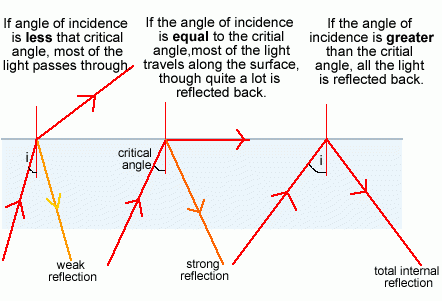
The refractive index and the critical angle are related by the following equation: Total internal reflection only occurs when the light ray propagates from a optically denser medium to an optically less dense medium.
Single Slit Diffraction
After passing through a narrow aperture (slit/gap/opening), a wave propagating in a specific direction tends to disperse. An example of this is when a wave passes through a narrow slit:
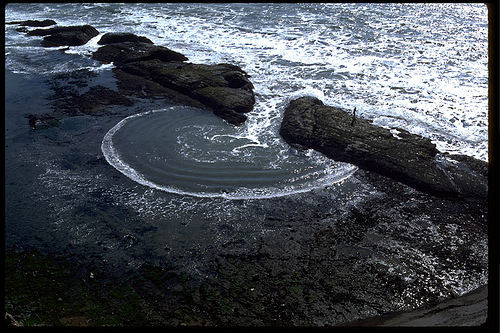
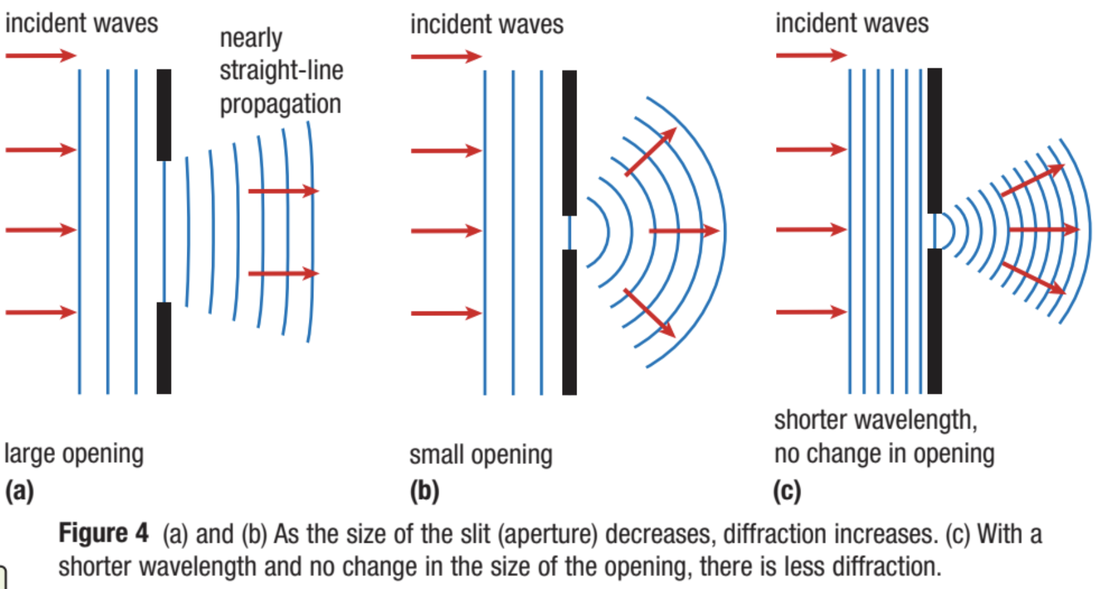
For this to be observed, the ratio of wavelength to slit ratio must be in a specific range: Diffraction of waves can only occur is the gap is narrow enough, and light (390-770nm) can only be diffracted with a narrow enough slit:
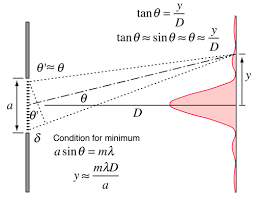
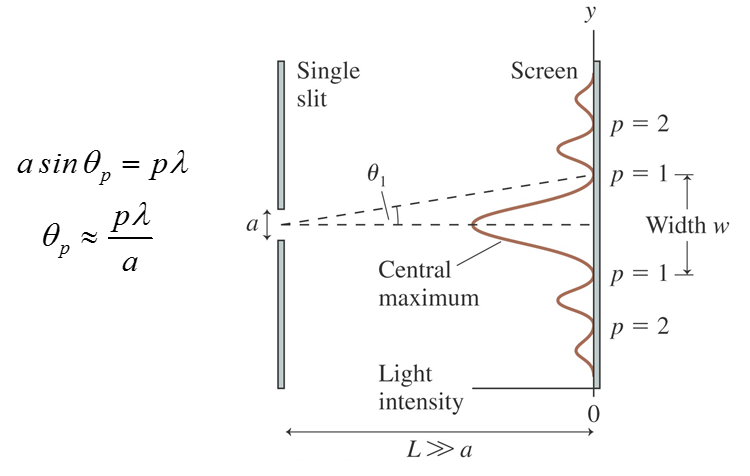
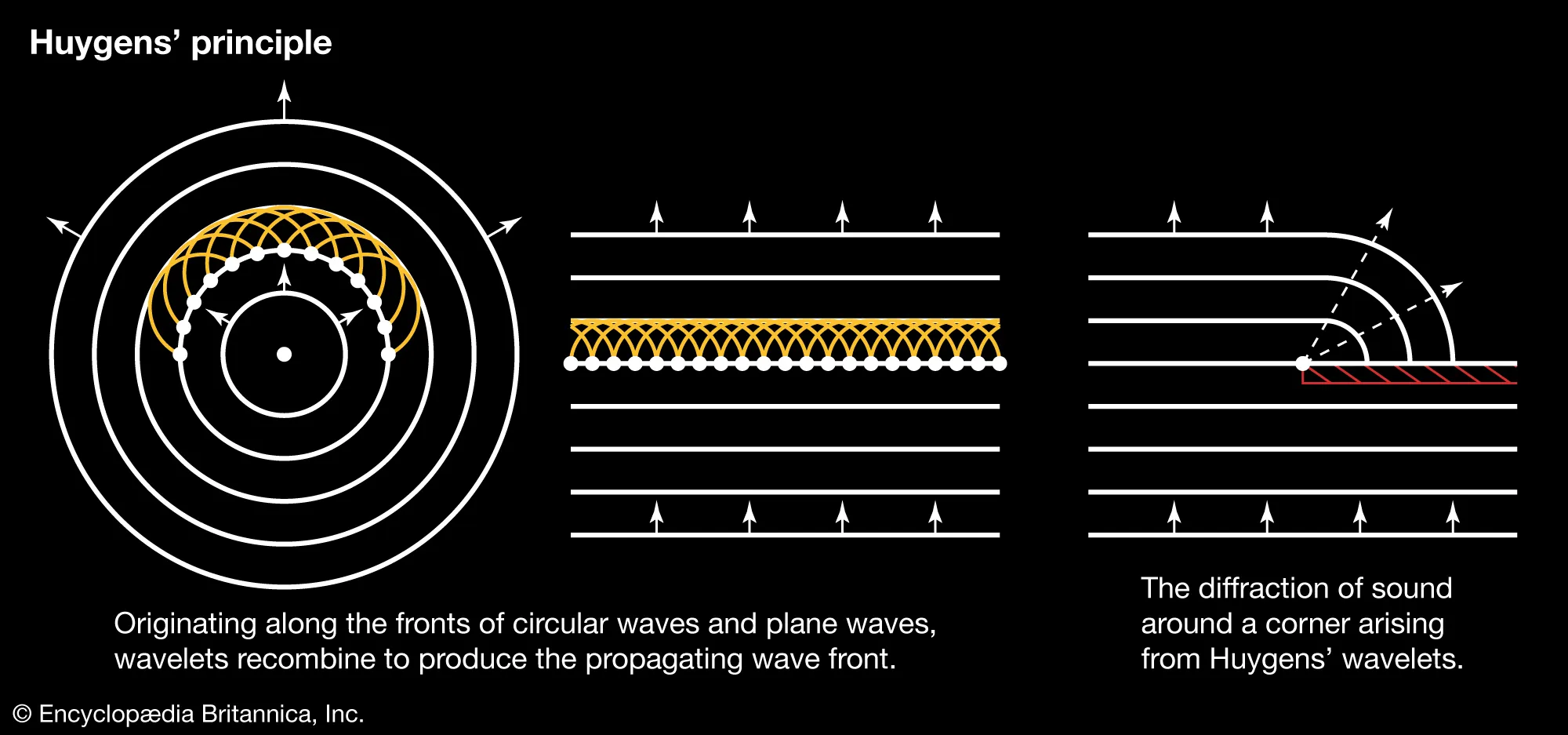
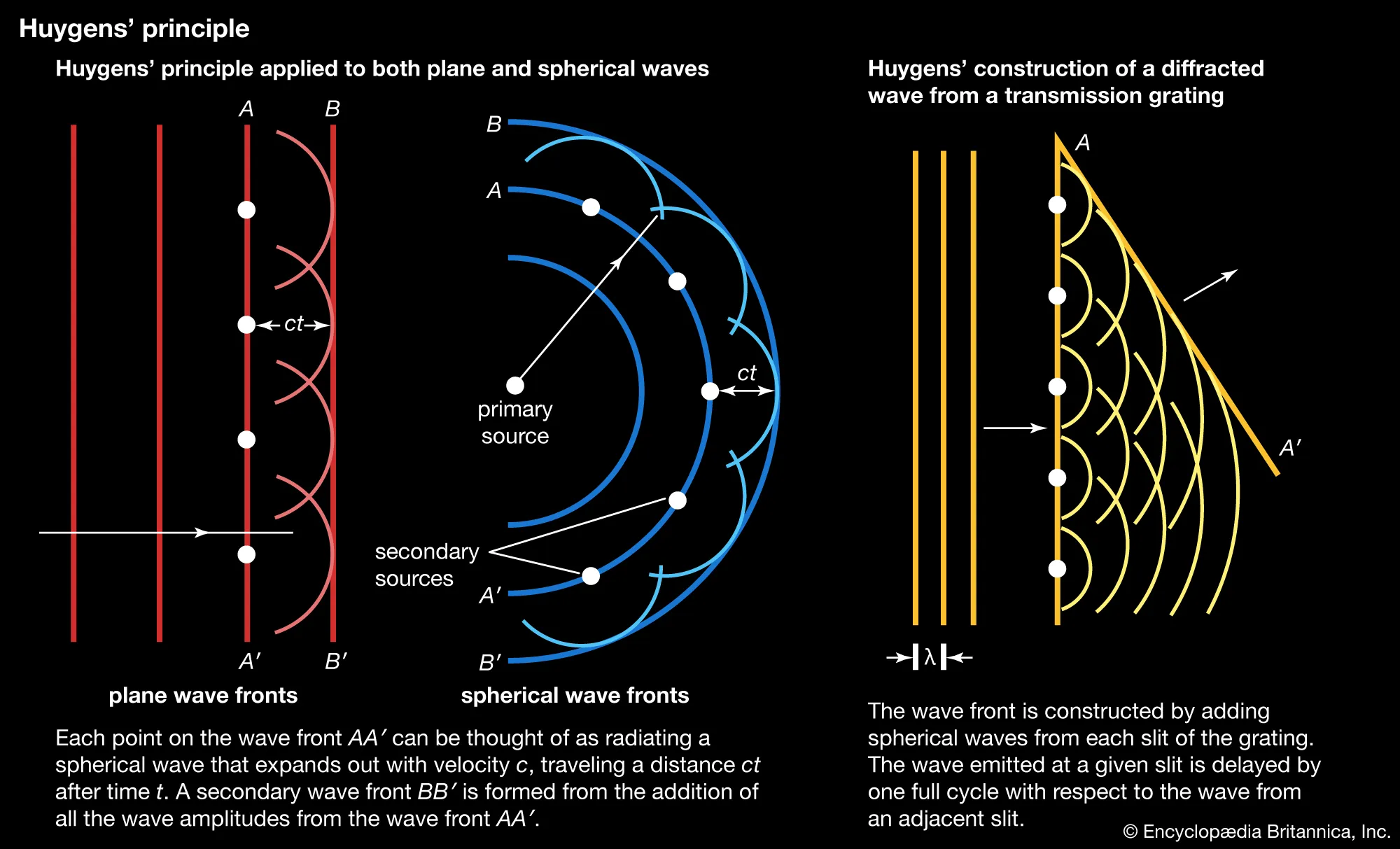
According to Huygens’ principle, every part of the wave front in the slit emits wavelets (rays that start out in phase and head in all directions, where each is perpendicular to the wave front of the wavelet.) In essence, each wave can be thought of as a line, made up of points. Each point emits a spherical ‘mini-wave’ and when it goes through a slit, it rounds out because there are no more spheres to make it straight.
Young’s Double Slit Experiment
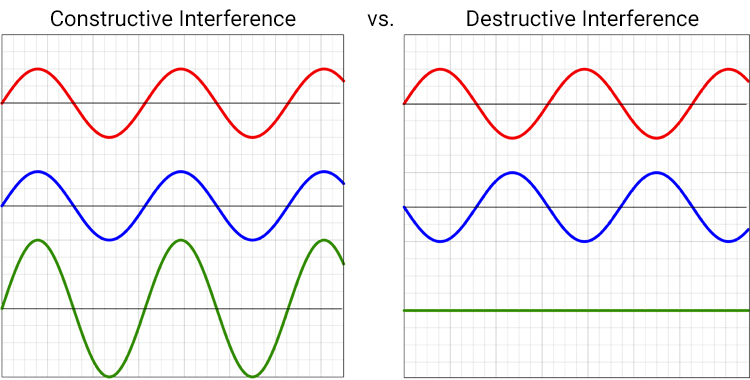
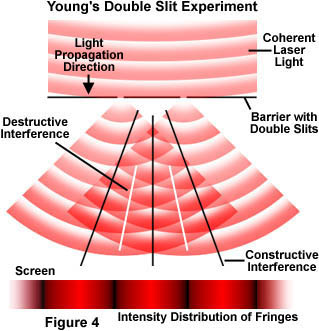
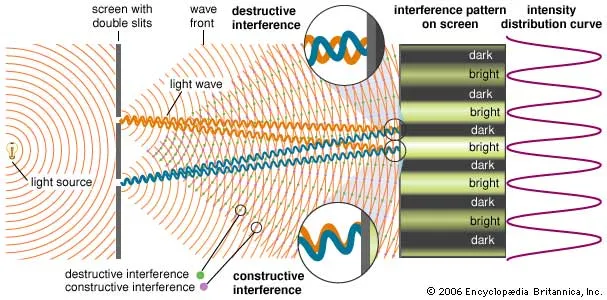
Given the dispersion seen in single slit dispersion, when two slits are next to each other, the wave’s interfere with each other: There are two extreme kinds of interference, destructive and constructive:
Constructive interference occurs when two crests or two troughs are at the same point: amplifying the two (or when two points of a wave of equal magnitude and amplitude superimpose on each other). e.g. wave A has a point of the wave with a height of 1, and wave B has a height of 1 at the same point. The resulting interference is constructive as the resulting amplitude is 2. Destructive interference occurs when a crest and a trough ‘cancel’ each other by having the same magnitude with ‘opposite’ amplitude: e.g. wave A has a point of the wave with a height of 1, and wave B has a height of -1 at the same point. When they interfere, they have a resulting height of 0 as they destructively interfere.
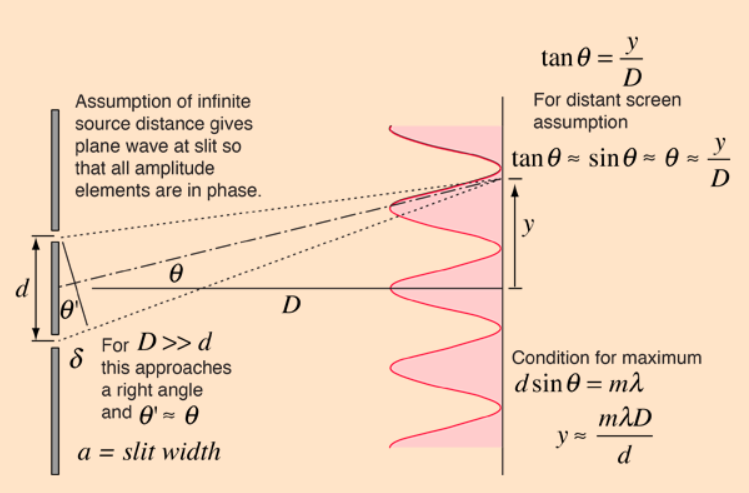
The resulting pattern that appears on a screen looks as follows:
Modulation of Two-Slit Interference Pattern by One-Slit Diffraction Effect
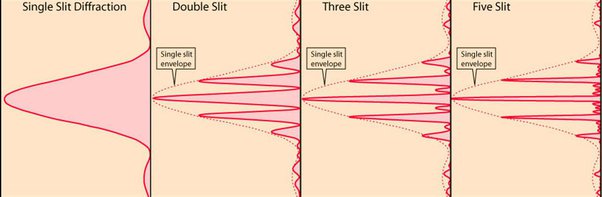
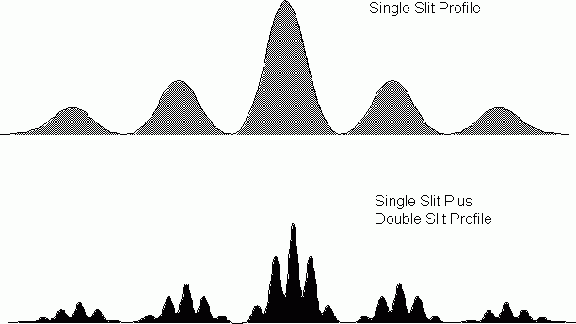
The previous section shows an ideal double-slit which ignores the single-slit characteristics of each of the two single-slits. A true double-slit would exhibit closely spaced dark and light areas (fringes) superimposed over the single-slit pattern. The single-slit profile is said to modulate the double-slit pattern.
Multiple Slit Diffraction
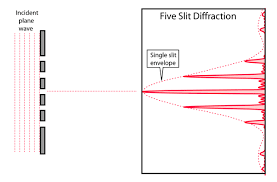
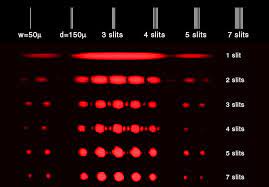
With each new slit introduced, the ‘subpeaks’ within a peak become increasingly extreme relative to their minimum intensities.