2024-11-1210:43 Status: Tags:
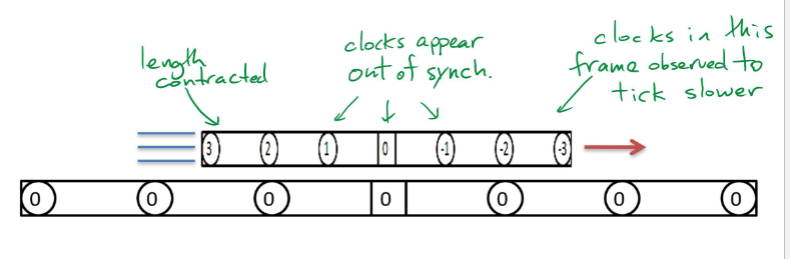
As a consequence of special relativity, the timing of events may be disrupted. An “event” is something that happens at a specific place at a specific time (e.g. receiving a text). If events and , occur with a given frame of reference, and they occur at the same time, they are simultaneous. Outside this frame, they may not occur at the same time.
A common depiction of this phenomena is with length contraction:
- is when the left sides align
- is when the right sides align In the following frame, they are simultaneous:
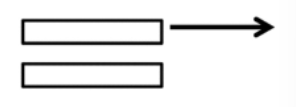
From the frame of reference of the top object, the top object will be observed to be longer because the observers in the other frame are seeing its contracted length. Contrarily, the length of the bottom object will be shorter as it is now the one “moving” in the frame of the top object. This contracts it. From the frame of the top object, the image looks like this:
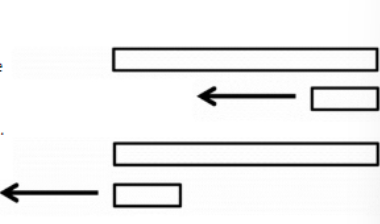
In this frame, event occurs before .
Another example: Suppose a train moves at a constant velocity along a track. People set a light to flash in the middle of the train so that the light reaches the front of the train and the back of the train at the same time (within the reference frame of the train).
For observers on the track, the light will reach the back of the train faster than it will for the front. If synchronized clocks were set up inside the train, the people inside would observe the light reaching the ends at the same time (say noon); but in the frame of the In the frame of the track the back clock will read noon while the front clock will read an earlier time (waiting for the light to come)
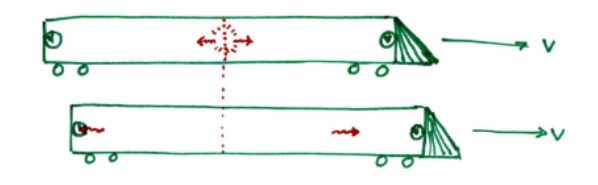
Because Time dilation & length contractions confuse the order of events, for observers in relative motion, each sees the other in a slower time. This is only possible because the order of separated events can be different in different frames.