2024-06-2501:56 Status:Pseudo
Tenses
Present
Present Tense Regular Verb Conjugation
| Pronoun | -ER | -IR | -RE |
|---|---|---|---|
| Je | - e | - is | - s |
| Tu | - es | - is | - s |
| Il/Elle/On | - e | - it | - / |
| Nous | - ons | - issions | - ons |
| Vous | - ez | - issez | - ez |
| Ils/Elles | - ent | - issient | - ent |
Instances in which present is used)
Examples of when this tense is used:
- Je bois du thé tous les jours. - I drink tea every day. This is a routine action. It is something that is done more than once.
- En ce moment, j’étudie le français. - At the moment, I’m studying French. This is a current action, something that is happening right now. There is no continuous present tense in French, eg ‘I am doing something’, so use the present tense for this.
- Elle est très grande. - She is very tall. This is a current fact about how things are at the present time.
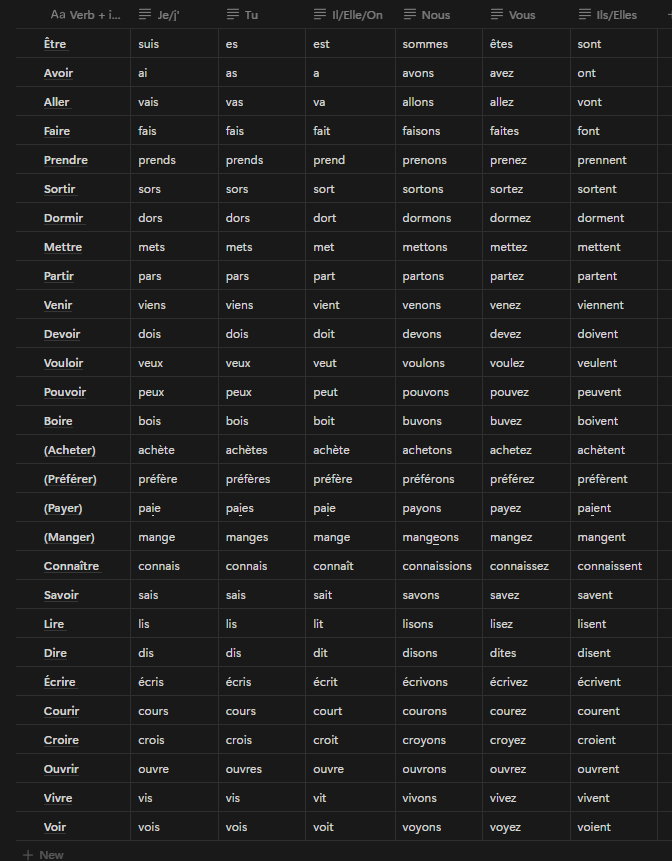
Common Irregular Conjugation
Close Future
(ALLER CONJUGATED + INFINITIVE) → E.x. Je vais nager
Recent Past
(VENIR CONJUGATED + ‘DE’ + INFINITIVE) → E.x. Je viens de nager
Passé Composé
Conjugating verbs with Avoir
Construction: subject pronoun + present conjugated form of avoir + past participle of ‘main verb
E.x. J’ai vu un = I saw one (PC has several English equivalents)
| - ER | - IR | - RE | |
|---|---|---|---|
| PC Conjugation | - é | - i | - u |
Examples:
- J’ai mangé, fini, rendu
- Tu as mangé, fini, rendu
- Il/elle a mangé, fini, rendu
- Nous avons mangé, fini , rendu
- Vous avez mangé, fini, rendu
- Ils/elles ont mangé, fini, rendu
Conjugating with Être
Verbs that follow the following conventions are:
- Monter, revenir, sortir, deviner, retourner, venir, aller, naître, descendre, entrer, revenir, tomber, renter, arriver, mourir, partir (passer)
Said conventions: subject pronoun + present conjugated form of etre + past participle of ‘main verb’. Where the ending of the conjugated past particle verb has to agree with the verb (adding an e or an s).
Transitive:
Avoir/Etre verbs: Monter, descendre, rentrer, sortir, retourner, passer, repasser, demeurer, (intransitive = rester, transitive = habiter for demeurer)
With negation:
- Je n’ai pas vendu; Tu n’es pas alle
Reflexive:
- Tu t’es lave, Nous nous sommes laves - always use etre
With negation and reflexive verb:
- Je ne me suis pas brosse
Irregular verbs in the past participle:
ASKING QUESTIONS IN PC
= ( … INTEROGATIVE FORM OF AVOIR + PAST PARTICIPLE … )
E.x. Est-ce que tu as travaillé
Imparatif
| Pronoun | -ER | -IR | -RE |
|---|---|---|---|
| Tu | - e | - is | - s |
| Nous | - ons | - issions | - ons |
| Vous | - ez | - issez | - ez |
| Only irregular in imperative = Être, Aller | |||
| Être) Tu sois, Nous soyons, Vous soyez | |||
| Aller) Tu va(no ‘s’), Nous allons, Vous allez | |||
| Imperative is primarily used to give commands/ tell someone to do something. |
E.x.
- Vendez voture voiture! Sell you car!
- Allons à la plage! Let’s go to the beach!
- Ferme la porte! Shut the door!
- Ouvre la fenêtre! Open the window!
- Lisez les phrases suivantes. Read the following sentences.
- Rentrez à la maison avant minuit! Come home before midnight!
- Téléphone à ta mère! Call you mother!
- Apprends les verbes! Learn the verbs!
Irregular Verbs
| Tu | Nous | Vous | |
|---|---|---|---|
| Avoir | aie! | ayons! | ayez! |
| Etre | sois! | soyons! | soyez! |
| Savoir | sache! | sachons! | sachez! |
| Aller | va | allons | allez |
| Faire | fais | faisons | faites |
| Negation for the imparitive: |
- Ne conduisez pas si vite! Don’t drive so fast!
- Ne bois pas mon café! Don’t drink my coffee!
- N’oublie pas ce que je te dis! Don’t forget what I’m telling you!
- Ne mange pas ses bonbons! Don’t eat their candy!
Reflexive and imperative:
In affirmative commands the pronoun comes after the verb and me/te become moi and toi. In negative commands the pronoun comes before the verb.
- Appelle-moi ce soir! Call me tonight!
- Ne m’appelle pas ce soir! Don’t call me tonight!
- Dépêche-toi! On va être en retard! Hurry up! We’re going to be late!
- Ne te dépêche pas! On a le temps! Don’t hurry! We have time!
Using imperative with pronouns:
There are certain situations in affirmative commands where pronouns follow the verb and are attached with a hyphen. In negative commands with pronouns, wrap ne…pas around the verb with the pronoun preceding the verb.
- Mange-le! eat it!
- Ne le mange pas. Don’t eat it!
- Donne-le-moi! Give it to me!
- Ne me le donne pas! Don’t give it to me!
- Téléphone-lui! Call him!
- Ne lui téléphone pas! Don’t call him!
Imparfait
(PRESENT NOUS CONJUGATIONN - ‘ONS’ PORTION + IMPERFECT ENDING)
The imperfect tense is used to describe a condition, habitual events or progressive actions (when interrupted = PC) = Imagine a scene on a stage; descirbe something that had passed; weather etc.
→ The only irregular verb = ETRE, having the stem ‘ét’
| Subject pronoun | Imperfect ending |
|---|---|
| Je | - ais |
| Tu | - ais |
| Il/elle/on | - ait |
| Nous | - ions |
| Vous | - iez |
| Ils/elles | -aient |
Futur Simple
Conjugation / formation
| Terminaisons du présent du verb AVOIR | Aimer - aimer | Finir - finir | Vendre- vendr_ |
|---|---|---|---|
| -ai | j’aimerai | je finirai | je vendrai |
| -as | tu aimeras | tu finiras | tu vendras |
| -a | il/elle/on aimera | il/elle/on finira | il/elle/on vendra |
| -ons | nous aimerons | nous finirons | nous vendrons |
| -ez | vous aimerez | vous finirez | vous vendrez |
| -ont | ils elles aimeront | ils/elles finiront | ils/elles vendront |
- A note regarding the future tense is that the letter ‘r’ always comes at the end of the infinitive - ir and -er verbs stay as is and verbs ending with -re drop the e and become -r.
- Verbs that have an ‘e’ at the end before/behind the ‘infinitive syllable’ become è
- Lever is conjugated for ‘I’ as ‘je lève’ in the present tense, so the future is formed as follows:
- {je lèverai, tu lèveras, il/elle/on lèvera, nous lèverons, vous lèverez and ils/elles lèveront}
- However, there is no change if there is an ‘é’ - e.g. répéter. → je répéter
- Lever is conjugated for ‘I’ as ‘je lève’ in the present tense, so the future is formed as follows:
- Words with a double letter when conjugated in the present also change to have a double letter.
- Appeler is conjugated for ‘I’ as ‘j’appelle’ in the present tense, so the future is formed as follows:
- {j’appellerai, tu appelleras, il/elle/on appellera, nous appellerons, vous appellerez, ils/elles appendront}
- Appeler is conjugated for ‘I’ as ‘j’appelle’ in the present tense, so the future is formed as follows:
- The pronunciation of words in the future whose infinitive ends with ier, uer, éer, and ouer are pronounced as i, u, é and ou respectively and by themselves. This is because the ‘e’ ending is not silent in that syllable.
- Verbs that end with an ‘ayer, oyer, uyer’ change their ‘y’s to ‘i’s in the future
- {je payerai/paierai, je nettoierai, j’essairai}
- Aller and envoyer are the only -er verbs on the list below that are irregular.
Irregular verbs and roots:
| Infinitive | Root | je/j’- | tu | il/elle/on | nous | vous | ils/elles |
|---|---|---|---|---|---|---|---|
| aller | ir- | irai | iras | ira | irons | irez | iront |
| avoir | aur- | aurai | auras | aura | aurons | aurez | auront |
| courir | courr- | courrai | courras | courra | courrons | courrez | courront |
| cueillir | cueiller- | cueillerai | cueilleras | cueillera | cueillerons | cueillerez | cueilleront |
| devoir | devr- | devrai | devras | devra | devrons | devrez | devront |
| envoyer | enverr- | enverrai | enverras | enverra | enverrons | enverrez | enverront |
| être | ser- | serai | seras | sera | serons | serez | seront |
| savoir | saur- | saurai | sauras | saura | saurons | saurez | sauront |
| faire | fer- | ferai | feras | fera | ferons | ferez | feront |
| falloir* | faudr- | ———— | ———— | faudra | ———— | ———— | ———— |
| mourir | mourr- | mourrai | mourras | mourra | mourrons | mourrez | mourront |
| pleuvoir* | pleuvr- | ———— | ———— | pleuvra | ———— | ———— | ———— |
| pouvoir | pourr- | pourrai | pourras | pourra | pourrons | pourrez | pourront |
| recevoir | recevr- | recevrai | recevras | recevra | recevrons | recevrez | recevront |
| -/s’assoir- | ? | ? | ? | ? | ? | ? | |
| tenir | tiendr- | tiendrai | tiendras | tiendra | tiendrons | tiendrez | teindront |
| valoir | vaudr- | vaudrai | vaudras | vaudra | vaudrons | vaudrez | vaudront |
| vouloir | voudr- | voudrai | voudras | voudra | voudrons | voudrez | voudront |
| venir | viendr- | viendrai | viendras | viendra | viendrons | viendrez | viendront |
| voir | verr- | verrai | verras | verra | verrons | verrez | verront |
- The conjugation of s’asseoir is both regular and irregular:
- Having the root of s’assiér- [ j’assiérai, …]
- Having the root of s’assi-
Emplois: Le futur est employé:
Future state
The future tense is also used to to express a future action or state in relation to the present: (Shall/will)
- Il lui écrira bientôt (action)
- Ce soir, je serai fatigué après ma longue journée (état)
After temporary conjunctions
The future simple is also used when an action will happen after a conditional statement, the verb will be in the future:
- Quand je mange cette pomme, je serai content.
- [Quand (when), aussitôt que (as soon as), pendant que (while), tant que (as long as), lorsque (when), des que (as soon as), tandis que (while/whereas)]
Conditional phrases
Conditional phrases are formed depending on the final state of the object:
| Hypothetical statement/condition | Consequence of that action/result | |
|---|---|---|
| Present | Si je dis oui, | il dit non. |
| Imperative | Si vous ne pouvez pas venir, | dites-le-moi. |
| Future simple | S’il fait beau demain, | nous pourrons sortir. |
Subjonctif
The subjective tense is used to express the necessity; obligation or a lack of certainty.
The formation of the subjective tense: [VERB OR EXPRESSION] + que + [SUBJECT] + [SUBJUNCTIVE VERB] …
Conjugation for regular verbs and some irregular verbs:
| Infinitive: | Parler | Finir | Vendre | Dire | Endings |
|---|---|---|---|---|---|
| Present stem: | ils parlent | ||||
| parl- | finissent | ||||
| finiss- | vendent | ||||
| vend- | disent | ||||
| dis- | |||||
| que je | parle | finisse | vende | dise | -e |
| que tu | parles | finisses | vendes | dises | -es |
| qu’il/elle/on | parle | finisse | vende | dise | -e |
| que nous | parlions | finissions | vendions | disions | -ions |
| que vous | parliez | finissiez | vendiez | disiez | -iez |
| qu’ils/elles | parlent | finissent | vendent | disent | -ent |
Expressions that use the subjunctive:
-
Il faut que (One must) + subjunctive; if negated can mean on must not/should not
[These obligations can also be expressed using devoir]
-
Il est bon que
-
Il est important que
-
Il est essentiel que
-
Il est indispensable que
-
Il est utile que
-
Il est naturel que
-
Il est normal que
-
Il est juste que
-
Il est dommage que
-
Il vaut mieux que
| Parler | ils parlent | parl- |
|---|---|---|
| Finir | ils finissent | finiss- |
| Vendre | ils vendent | vend- |
| S’asseoir | ils s’asseyent | s’assey- |
| Connaitre | ils connaissent | connaiss- |
| Dire | ils conduisent | dis- |
| Dormir | ils disent | dorm- |
| Ecrire | ils ecrivent | ecriv- |
| Lire | ils lisent | lis- |
| Mentir | ils emntent | ment- |
| Mettre | ils mettent | mett- |
| Ouvrir | ils ouvrent | ouvr- |
| Partir | ils partent | part- |
| Reconnaitre | ils reconnaissent | reconnaiss- |
| Sentir | ils sentent | sent- |
| Sortir | ils sortent | sort- |
| Suivre | ils suivent | suiv- |
| Vivre | ils vivent | viv |
To express ‘I would like you to’ kind of sentences: Je veux que tu sortes avec moi.
- Je prefere que …
- Je souhaite que (I wish) …
- Je desire que (I wish) …
- Je voudrais que …
- J’aimerais que …
- Je veux que …
- J’instiste pour que …
- J’exige que (I demand) …
Some verbs like venir have different stems; taking the nous and ils present forms while still having normal endings [-e, -es, -e, -ions, -iez, -ent]
Verbs like venir = [Acheter, Esperer, Appeler, Payer, Boire, Voir, Prendre]
| Infinitive | Venir |
|---|---|
| Present | Ils viennent |
| nous venons | |
| Subjonctive | que je vienne |
| que tu viennes | |
| qu’il vienne | |
| que nous venions | |
| que vous veniez | |
| qu’ils viennent |
| Irregular verbs: | Etre | Avoir | Aller | Faire | Savoir | ||
|---|---|---|---|---|---|---|---|
| que je (j’) | sois | aie | aille | fasse | sache | ||
| que tu | sois | aies | ailles | fasses | saches | ||
| qu’il/ elle/ on | soit | ait | aille | fasse | sache | ||
| que nous | soyons | ayons | aillions | fassions | sachions | ||
| que vous | soyez | ayez | alliez | fassiez | sachiez | ||
| qu’ils/elles | soient | aient | aillent | fassent | sachent |
Conditional (from Futur Simple)
Plus que Parfait
Le Futur Antérieur
The future prior is a tense used to communicante an action that precedes the action happening in the future.
Grammar
Reflexive
PRESENT TENSE
| Tense | Reflexive example |
|---|---|
| Present | - Je me (m’) lave |
- Tu te (t’) laves
- Il/elle/on se (s’) lave
- Nous nous lavons
- Vous vous lavez
- Ils/elles se (s’) lavent | | Negative | Je ne me lave pas | | Interrogative | Est-ce que tu te laves? |
Formed: (REFLEXIVE PRONOUN + VERB = REFLEXIVE VERB
→ Je me lave les mains NOT (mes)
- Affirmative: Repose-toi
- Neg. affirmative: Ne te repose pas
PC TENSE
(SUBJECT + REFLEXIVE PRONOUN + PRESENT FORM OF ETRE + PAST PARTICIPLE = PC FORM OF REFLEXIVE VERB)
| Affirmative | - Je me suis lavé(e) - Tu t’es lavée - Il/elle/on s’est lavé(e) - Nous nous sommes lavé(e)s - Vous vous êtes lavé(e/s) - Ills/Elles se sont lavé(e)s |
|---|---|
| Negative | Je ne me suis pas lavé(e) |
| Interrogative | Tu t’es lavé(e)s? |
Negation
In the present tense:
In the present tense, negation is formed by wrapping ne…pas around the verb.
- Je ne mange pas. I don’t eat.
- Il ne dort pas. He doesn’t sleep.
- Nous ne travaillons pas. We don’t work
In the passe compose
In the passé composé (French past tense) wrap ne…pas around the auxiliary (helping) verb. For example, to say ‘I didn’t eat’, say ‘Je n‘ai pas mangé’. Note, a common mistake is to put the pas after the past participle and say, ‘Je n’ai mangé pas’. This wrong. It is tempting to make this mistake because the pas comes after the verb in the present tense: ‘Je ne mange pas’. Once again, the rule is to wrap ne…pas around the auxiliary verb.
- Je **n’**ai pas parlé. I did not speak.
- Ils **n’**ont pas voyagé. They did not travel.
- Il **n’**est pas venu. He did not come.
Rules for reflexive - present
For reflexive verbs in the present tense, wrap ne…pas around the verb and the reflexive pronoun. For example, I get in up in affirmative is: ‘Je me lève’. The ‘me’ is the reflexive pronoun and it means ‘to myself’. Hence, to negate, the ne…pas goes around the ‘me’: Je ne me lève pas.
- Il ne se rase pas. He isn’t shaving.
- Elle ne se maquille pas. She isn’t putting on make-up.
Rules for reflexive - passe compose
For reflexive verbs in the passé composé, wrap ne…pas around the reflexive pronoun and the auxiliary verb. In the affirmative, ‘Je me suis levé’ means I got up. For the passé composé, ne…pas goes around the auxiliary verb (suis) and past participle (levé). Hence, ‘Je ne me suis pas levé’ is ‘I didn’t get up.
- Il ne s’est pas blessé. He did not get injured.
- Elle ne s’est pas levée. She did not get up.
- Ils ne se sont pas promenés. They did not take a walk.
Special negations:
French has several other types of negation where other words than ‘pas’ make the negation. These can be referred to as negative adverbs and the most common examples are: ne…jamais (never), ne…rien (nothing, anything) and ne…personne (nobody, anybody) replace the word pas.
- Elle ne voyage jamais. She never travels.
- Il **n’**écoute jamais. He never listens.
- Nous ne nageons jamais. We never swim
- Je **n’**ai jamais mangé le fois gras. I’ve never eaten fois gras
Negative structures surround the conjugated verb:
E.x. Je n’ai jamais vu un (I have never seen one)
Inversion
E.x. Tu as un livre → As-tu un livre
- (Yes/no question follow the following format: VERB + SUBJECT PRONOUN + REST)
*In inverted questions, the verb and subject pronoun are joined with a hyphen. The sound ‘t’ is pronounced between the subject pronouns leading with a vowel. (il(s),elle(s),on) E.x. Elle travaille? → Travaille-t-elle?
- (Information based questions follow the following format: INTEROGATIVE EXPRESSION + VERB + SUBJECT PRONOUN + REST)
E.x. Quand travaillez-vous?
Relative Pronouns
Articles
| Use | To describe | Type |
|---|---|---|
| le, la, l’, les | A specific thing/general sense of a noun | Definite articles |
| un, une, des | One or several items (no specific) | Indefinite articles |
| de, de la, de l’, des , du | Some portion of something/a certain amount | Partative articles |
→ When referring to one’s body part use definite articles instead of possessive
(Some/no)(one/thing)
| Something | Nothing | Someone | No one | |
|---|---|---|---|---|
| PRESENT | Je fais quelque chose | Tu ne fais rien | J’invite quelqu’un | Tu n’invites personne |
| PC | J’ai fait quelque chose | Tu n’as rien fait | J’ai invite quelqu’un | Tu n’as invité personne |
Articles ‘y’ and ‘en’
THE PRONOUN ‘Y’ = THERE
Used with/in place of à, en, dans, chez, etc.
→ Tu was à la plage = Oui, j’y vais souvent OR Non, je n’y vais pas
The pronoun ‘y’ comes before the conjugated verb, excluding affirmative commands
→ Vas-y (Go on), On y va (Lets go), Allons-y (Let’s go)
THE PRONOUN ‘EN’ = (/…SOME/ANY)
Used in place of partitive articles = du, de la, des de l’, d’, de + noun
→ E.x. je voudrais de la limonade = j’en voudrais
The pronoun ‘en’ comes before the conjugated verb, excluding affirmative commands
→ Comes between y + a in ‘il y a’ → ‘il y en a’
Un + une are included at the end
→ (In negative sentences un/une is omitted)
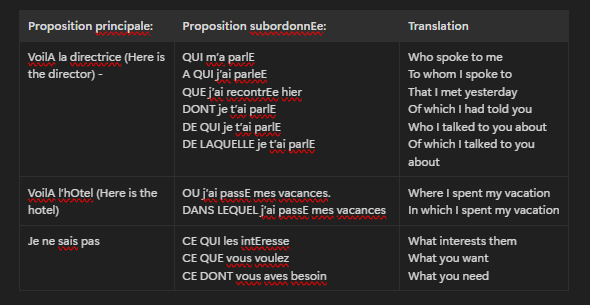
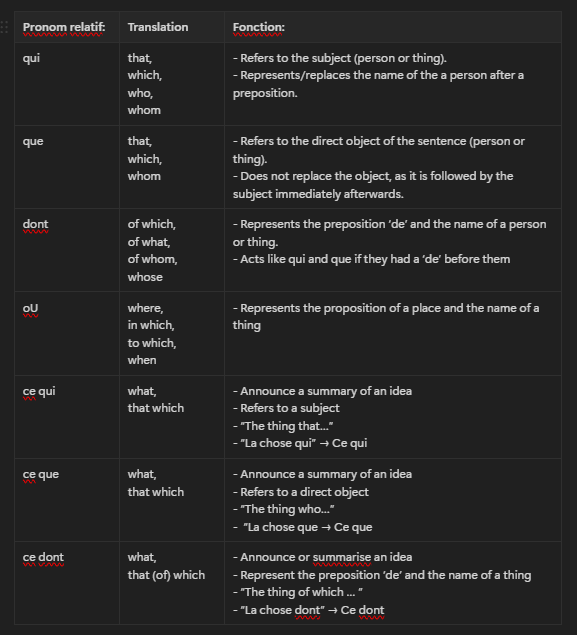
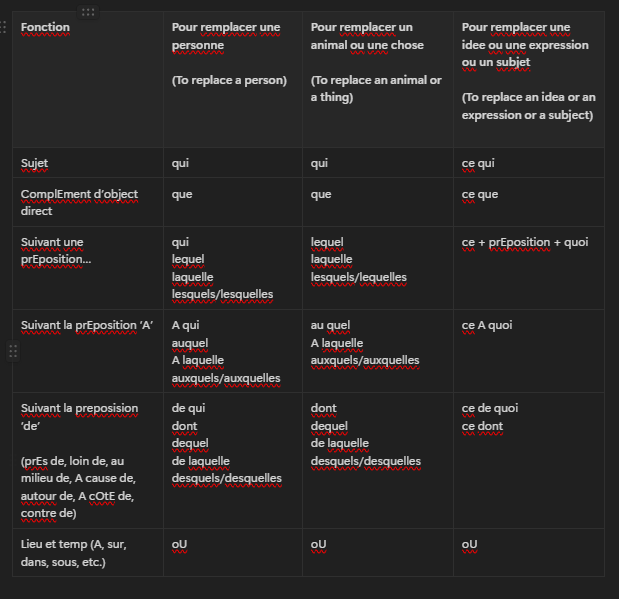
Relative Pronouns + ‘Qui’ vs. ‘Que’
A relative pronoun introduces a subordinate clause and connects the subordinate clause to the original clause. For instance, the relative pronouns, ‘that’ and ‘who’ extend a sentence.
Qui replaces the subject (pronoun) and is the subject of the verb that follows
Que is the direct object of the verb that follows it. (Extends sentence)
Indefinite Pronouns
| Le pronom | Exemples | Attention |
|---|---|---|
| Quelqu’un(e) | Quelsu’un m’a racontE la nouvelle. | J’ai recontrE quelqu’un DE spEcial |
| Quelsunes-un(e)s | Il a va quelques-uns de ses amis. | / |
| Quelque chose | As-tu dit quelque schose? | Quelque chose d’intEressant m’est arrivE |
| Rien | On ne m’a rien demandE. | Rien de sErieux n’est arrivE. |
C’est vs. Il est
- C’est + (Name)
- C’est + (Article + noun + (adjective))
- C’est (Article + adjective + noun)
- Il/Elle/On est + (Adjective)
C’est is also used with ‘mon’/’ma’ E.x. C’est mon copain
Negative singular E.x. Ce n’est pas ( Plural = Ce ne sont pas)
There are two ways to refer to one’s profession: Elle est (NO ARTICLE) architecte. Or: C’est une architecte
COD and COI
| Subject pronoun | Direct Object | Indirect object |
|---|---|---|
| Je | me (m’) | me (m’) |
| Tu | te (t’) | te (t’) |
| Il/Elle/On | le/la/l’ | lui |
| Nous | nous | nous |
| Vous | vous | vous |
| Ils/Elles | les | leur |
DIRECT OBJECT PRONOUNS
Replace the who/what of the sentence.
E.x. Le/la/les English equivalent = him/her/it/them
Affirmative → Il regarde la télé = Il la regarde
Negative → Il ne la regarde pas
Inversion → La regarde-t-il
INDIRECT OBJECT PRONOUNS
Answer the question to whom (using ‘à’/‘au’/ aux)
E.x. Tu téléphones à ta soeur? → (X), je (ne) lui téléphone (pas)
→ The indirect object pronoun goes before the conjugated verb (after ‘ne’) 3
Connaître and Savoir
Connaître and savoir both generally mean to know; however they are used only under specific circumstances.
Connnaître is used to describe/to…
- know/be aquainted with something
- ‘things’
- people, places
Savoir is used to
- To know that …
- To know if
- Ask questions e.x. so you know if
- To know how to do something
Adjectives and Adverbs
REGULAR ADJECTIVES
| Singular | Plural | |
|---|---|---|
| Masculine | - (petit) | - s (petits) |
| Feminine | - e (petite) | - es (petites) |
- Placement of adjectives usually come after the noun
- Beau, nouveau, vieux become bel, nouvel and vieil before a masculine noun starting with a vowel
- Exceptions = adjectives that modify: E.x.( Grand, petit, bon, mauvais, beau, nouveau, vieux, joli, jeune
IRREGULAR ADJECTIVES
| Adjective | M/S | M/P | F/S | F/P |
|---|---|---|---|---|
| -eux | -eux | -eux | -euse | -euses |
| -al | -al | -aux | -ale | -ales |
| -if | -if | -ifs | -ive | -ives |
| -el | -el | -els | -elle | -elles |
| -on | -on | -ons | -onne | -onnes |
| -en | -en | -ens | -enne | -ennes |
ORDINAL NUMBERS
Number (-e is any) + ième e.x. deux → deuxième
Exceptions: un(e)→ premier/première, cinq→ cinquième, neuf→ neuvième
CREATING ADVERBS
Feminine (excluding masculine forms that end with -i or -e) + ment
COMPARING ADJECTIVE
Plus (more), moins (less), aussi (as much as) … adjective … que (than) bien (well), mieux (better)
→ Superlative = the best/worst etc. le/la/les
| Which one(s) | Singular | Plural |
|---|---|---|
| Masculine | lequel | lesquels |
| Feminine | laquelle | leasquelles |
| That one/those ones | Singular | Plural |
|---|---|---|
| Masculine | celui | ceux |
| Feminine | celle | celles |
You can add -ci (here) or -là (there) to add specificity
(Re)Sources
(IB French Curriculum): (https://www.student.thinkib.net/)
(https://www.tutorchase.com/blog/ib-french-a-complete-guide)
Podcastfrancaisfacile Les 500 Exercise de phonetique book YouTube videos Daily verb conjugations [Conjugations progressive du francais, francais facile] 1 video Inner French Readlang InnerFrench podcast Bref YouTube
https://www.bbc.co.uk/bitesize/guides/z6dx382/revision/1 Efficient training of French listening - Intermediate Level French Listening for Beginners (recorded by Real Human Voice) IB French Ab Initio Folder | Quizlet (https://global.oup.com/education/content/secondary/series/ib-french-b/?region=international The Best Resources to Learn FRENCH for Free Online • Gratis Global https://www.typing.com/student/lesson/378/advanced-symbols https://ebooks.papacambridge.com/directories/IB/IB-ebooks/upload/french%20b%20-%20course%20companion%20-%20christine%20trumper%20and%20john%20israel%20-%20first%20edition%20-%20oxford%202012.pdf