2024-07-0918:26 Status:IBnotes
Quarks & Leptons
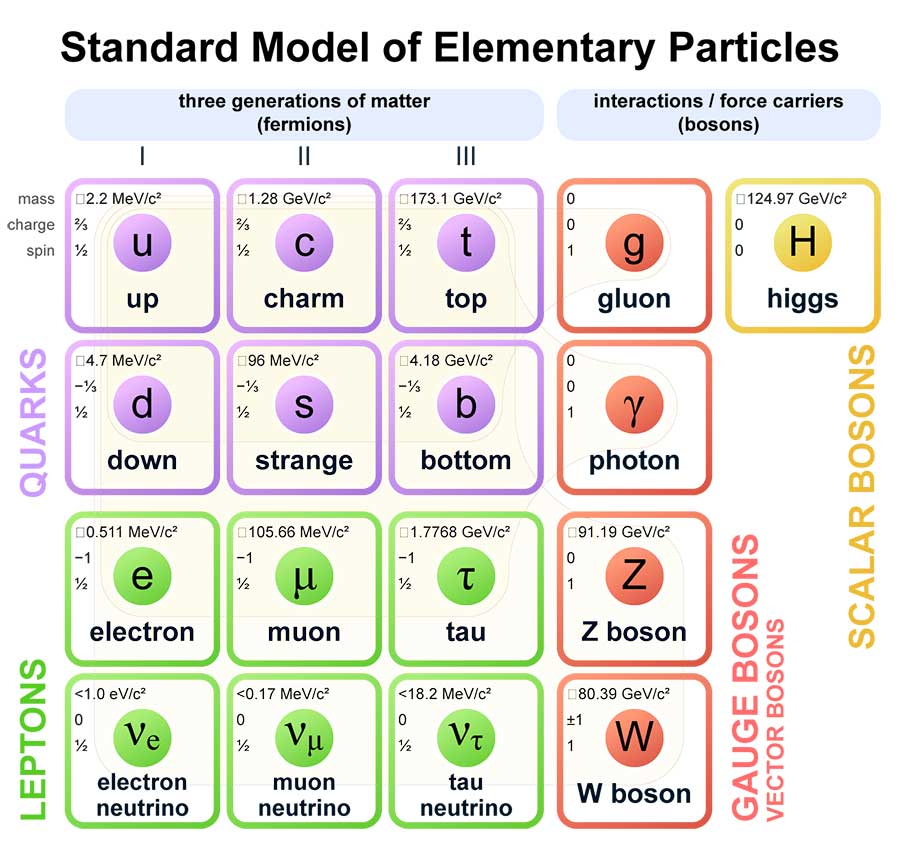
Quarks and leptons are the elementary particles (building blocks) of matter. Each particle also has an antimatter counterpart. When matter collides with its corresponding antimatter, the particles annihilate and release energy by mass-energy equivalence.
Hadrons, Baryons & Mesons
As stated in the previous section, the elementary particles of matter comprises of quarks and leptons. Hadrons are made up of quarks and are identified in the same classification level as leptons. Unlike leptons, which do not experience the strong nuclear force, hadrons experience all four fundamental forces. Hadrons are generally larger than leptons. Hadrons are sub-divided into baryons and mesons. Baryons and mesons are made up of different types of quarks and antiquarks.
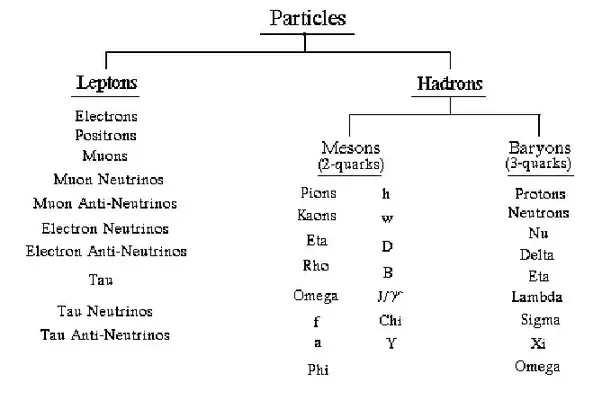
By combining quarks, new particles emerge based on the quark content. There are about 120 types of baryons (where baryons are considered to be fermionic hadrons). There are about 140 types of mesons (where mesons are considered to be bosonic hadrons.)
| Symbol | Name | Quark Content | Electric Charge | Mass | Spin |
|---|---|---|---|---|---|
| Proton | +1 | 0.938 | 1/2 | ||
| Antiproton | -1 | 0.938 | 1/2 | ||
| Neutron | 0 | 0.940 | 1/2 | ||
| Lambda | 0 | 1.116 | 1/2 | ||
| Omega | -1 | 1.672 | 3/2 | ||
| Pion | +1 | 0.140 | 0 | ||
| Kaon | -1 | 0.494 | 0 | ||
| Rho | +1 | 0.770 | 1 | ||
| B-zero | 0 | 5.279 | 0 | ||
| Eta-c | 0 | 2.980 | 0 | ||
| where u represents up quarks, d represents down quarks, c represents charm quarks, s represents strange quarks, (t represents top quarks), b represents bottom quarks, and the line above the representative letter of the quarks indicate its corresponding antiquarks. |
- The conservation laws of charge, baryon number, lepton number and strangeness
- When writing equations, we already know that the charge of the reactants and the products must be identical due to the conservation law of charge.
- In particle physics, other than the conservation of charge, the baryon number, lepton number, and strangeness must also be conserved.
- Baryons have a baryon number of +1, antibaryons have a baryon number of -1, leptons have a lepton number of +1, and antileptons have a lepton number of -1.
- The conservation of strangeness (strange quark) only occurs within interactions of the strong nuclear force, while the conservation of the other three properties apply to all interactions.
Exchange Particles
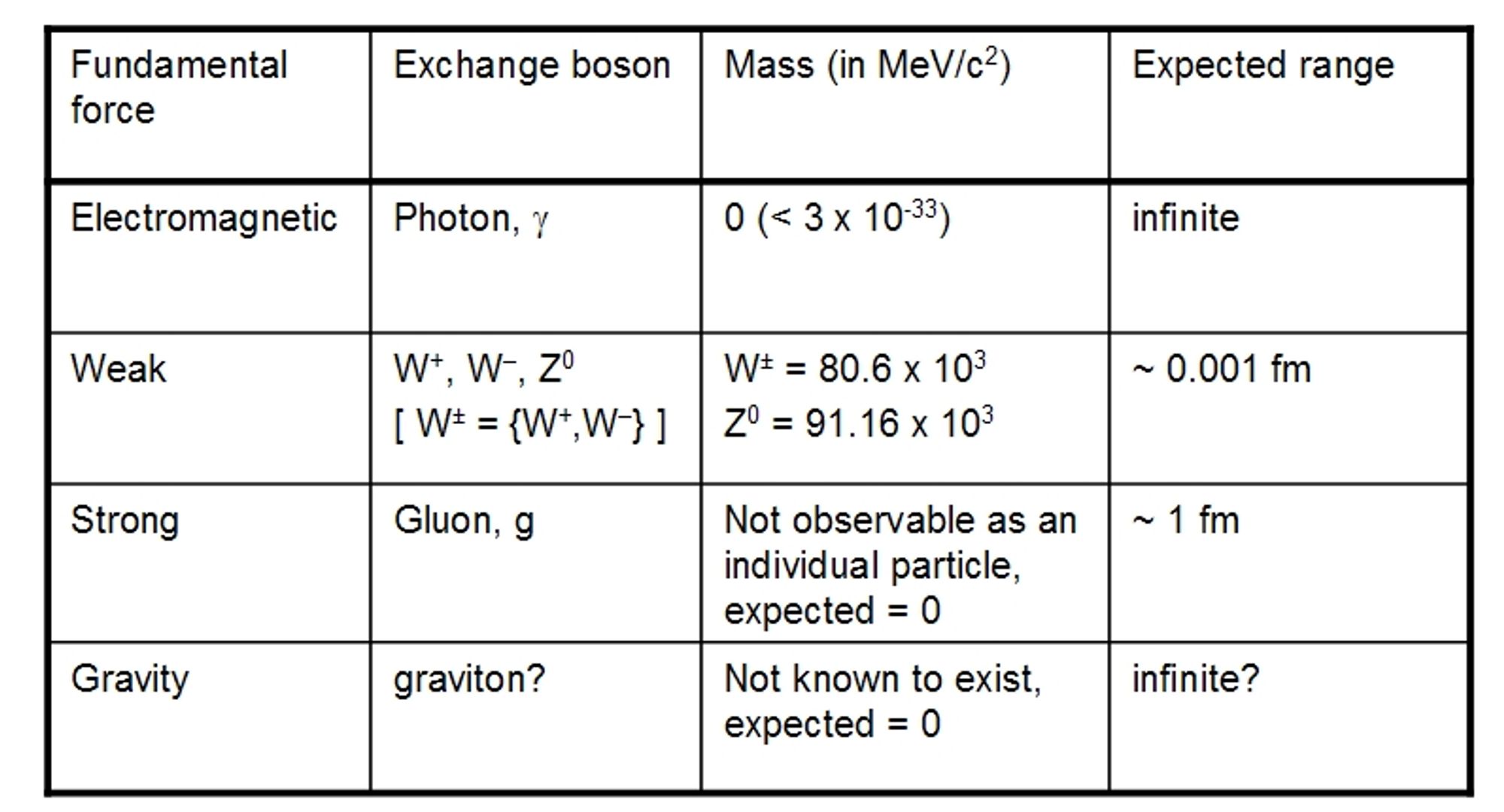
The exchange particle acts as a force carrier between particles (aka a virtual particle). It only exists for a very brief period of time and is not observed.
Feynman Diagrams
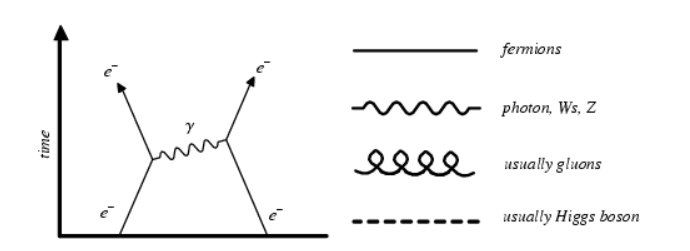
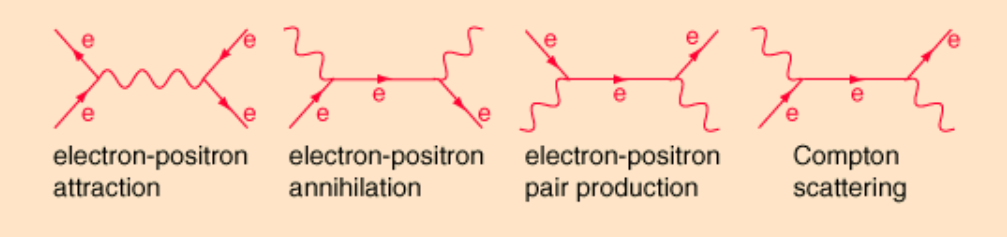
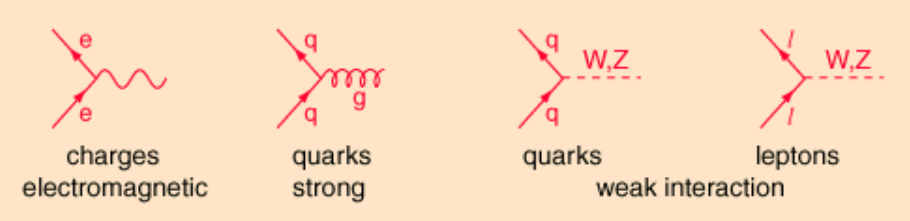
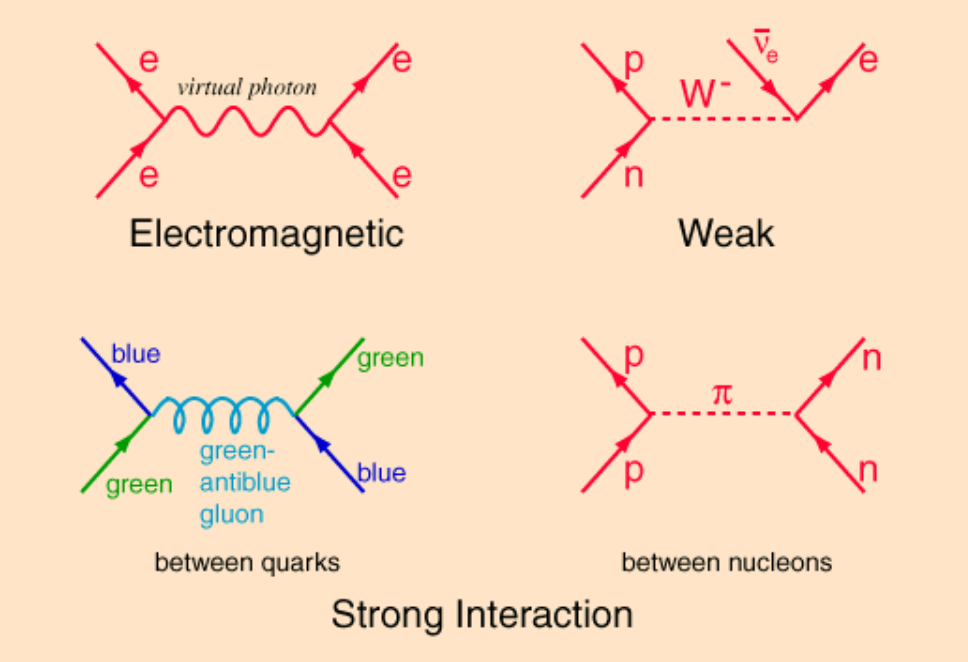
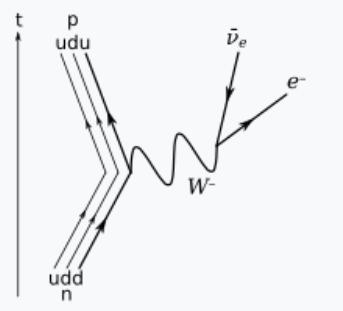
Feynman diagrams, introduced by physicist Richard Feynman, can be used to express the behavior of subatomic particles over time. Feynman diagrams are read from the left to the right where the x-axis shows time and the y-axis shows roughly the space direction of the subatomic particle interactions. Some Feynman diagrams, such as the examples given below, switch the x-axis and the y-axis where the progression of the interactions with time is read upwards:
Further guide to Feynman Diagrams: https://www.quantumdiaries.org/2010/02/14/lets-draw-feynman-diagams/ however here are some common ones: https://en.wikipedia.org/wiki/List_of_Feynman_diagrams; http://hyperphysics.phy-astr.gsu.edu/hbase/Particles/expar.html
Beta decay:
Confinement
Quarks and gluons (massless subatomic particles that transmit the force binding quarks together in a hadron) are color-charged particles. Similar to electrically-charged particles which interact by exchanging photons in electromagnetic interactions, color-charged particles exchange gluons in strong force interactions. Note that color charge has nothing to do with visible colors. It is just an expression.
When two quarks are close to each other, they exchange gluons and create a strong color force field that binds quarks together. The force field gets stronger as the quarks get further apart. Quarks constantly change their color charges as they exchange gluons with other quarks. There are 3 color charges and 3 corresponding anti-color charges.
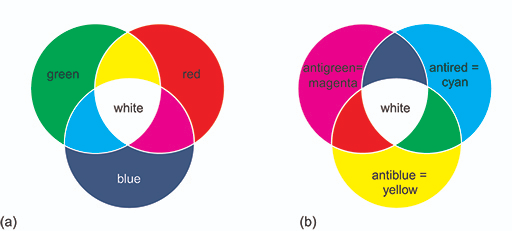
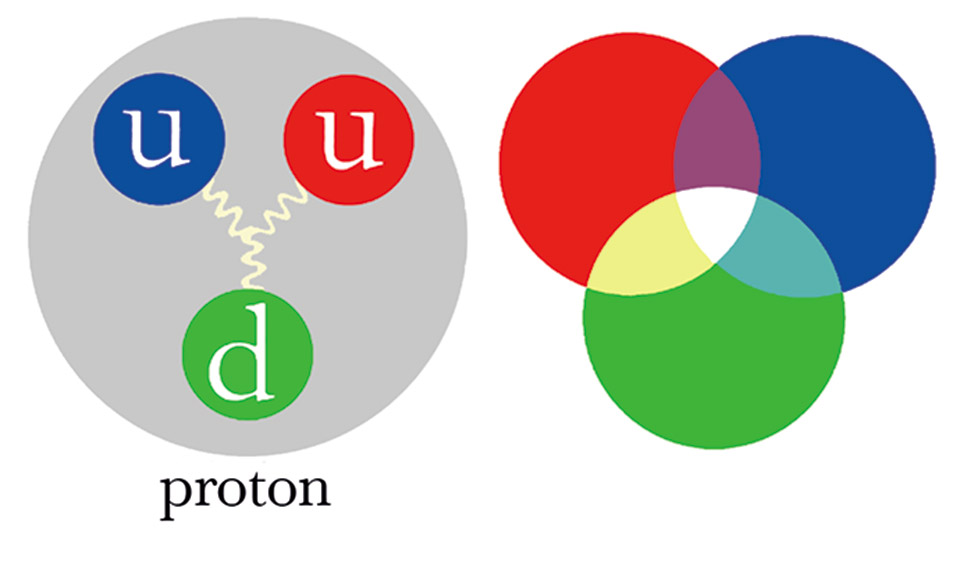
Just as mixing red, blue, and green visible colors yield white, mixing red, blue, and green color charges yield color neutral.
Color confinement is a phenomenon that color-charged particles cannot be isolated singularly and therefore cannot be directly observed. The color-charged quarks are said to be confined in groups (hadrons) with other quarks which composite to color neutral and cannot be distinguished separately. This is because the color force increases as the color-charged quarks are pulled apart.
TL;DR: Color confinement or quark confinement is the phenomenon when isolated quarks and gluons cannot be observed.
Higgs Boson
In addition to the three generations of leptons and quarks (see previous section (Quarks, leptons and their antiparticles)), there are four classes of bosons and an additional highly massive boson called the Higgs boson. This particle was proposed in 1964 to explain the process which particles can acquire mass and was identified with the Large Hadron Collider (LHC).
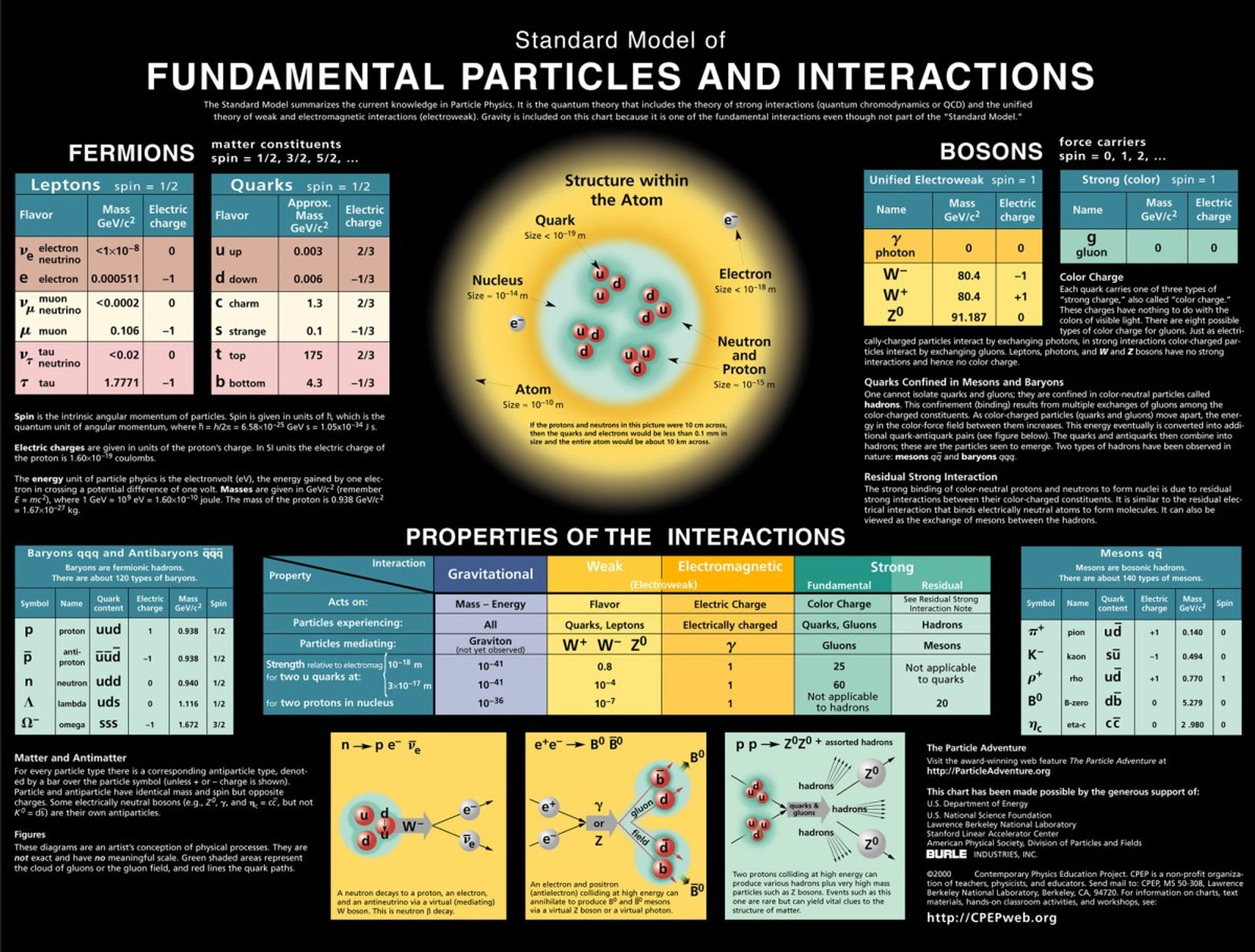
Summary of Fundamental Particles and Interactions
Progression of the Model of the Atom