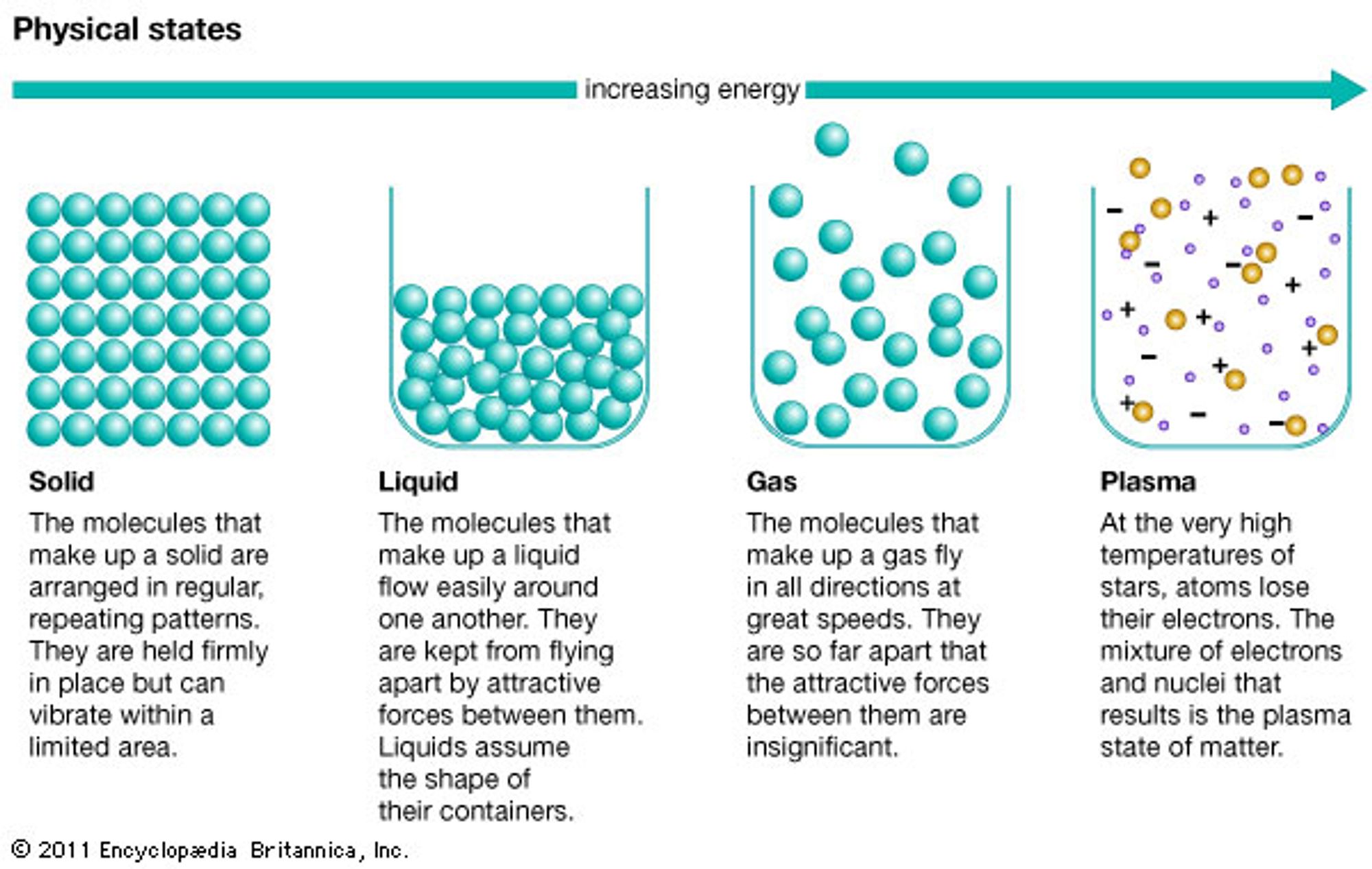
Molecules are held together by intermolecular forces.
The fourth state of plasma is not required to be learned in the current syllabus.
Temperature and Absolute Temperature
Temperatures describe how hot or cold an object is and determines the direction of heat flow between two bodies.
Thermal energy transfers from an object with higher temperature to another object with lower temperature. The energy transfer is called heat (the flow of energy due to temperature difference). Objects which are in thermal equilibrium have the same temperature.
Kelvin to Celsius
Tc=K−273.15
The absolute temperature of a body in the Kelvin scale is directly proportional to the average kinetic energy per molecule inside the body.
Absolute zero is 0K or -273 degrees Celsius.
Temperatures cannot be lower than absolute zero. It is the temperature where particles have zero average kinetic energy (no random motion).
Internal Energy
Internal energy is the sum of total kinetic energy (total thermal energy) and total potential energy.
Kinetic energy is energy associated with the random/translational rotational motions of molecules.
Potential energy is associated with forces between molecules.
Specific Heat Capacity
The specific heat capacity of a substance is given by:
Q=mcΔT
Where Q is the energy (heat) of a body, mJ is the mass (kg), c is the specific heat capacity,(kg°CJ)and ΔT is the change in temperature, (°C,K)
The thermal capacity of an object is given by Q=cθ (or Q=cΔT) and is defined by the amount of heat needed to raise an object’s temperature by 1K.
Phase Change
Change of phase
Process
Kinetic energy
Potential energy
Solid to liquid
Melting
Unchanged
Increases
Liquid to solid
Freezing
Unchanged
Decreases
Liquid to gas
Boiling
Unchanged
Increases
Gas to liquid
Condensation
Unchanged
Decreases
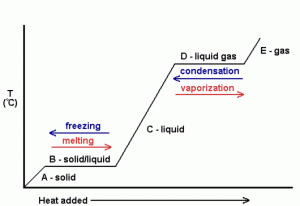
During a phase change, temperature and kinetic energy remain constant and potential energy changes (which increases as molecules spread out and vice versa).
Boiling: Only occurs at the boiling point (a specific temperature depending on substance) and occurs throughout the liquid.
Evaporation: Can occur at any temperature and only occurs at the surface of the liquid. The fastest moving particles evaporate, decreasing the average KE of the remaining particles. As a result, temperature drops.
Specific Latent Heat
Specific latent heat of fusion: The amount of heat required to change 1kg of a substance from solid to liquid without any change in temperature.
Specific latent heat of vaporization: The amount of heat required to change 1kg of a substance from liquid to gas without any change in temperature.
The specific latent heat of a substance is given by
Q=mL
Where Q is the heat change (J), m is mass (kg), L is the specific latent heat (kgJ).
Weight and Pressure !!
Pressure:
Pressure is defined as the normal force per unit area and can be expressed with the formula:
Pressure=AreaForce
Ideal Gases
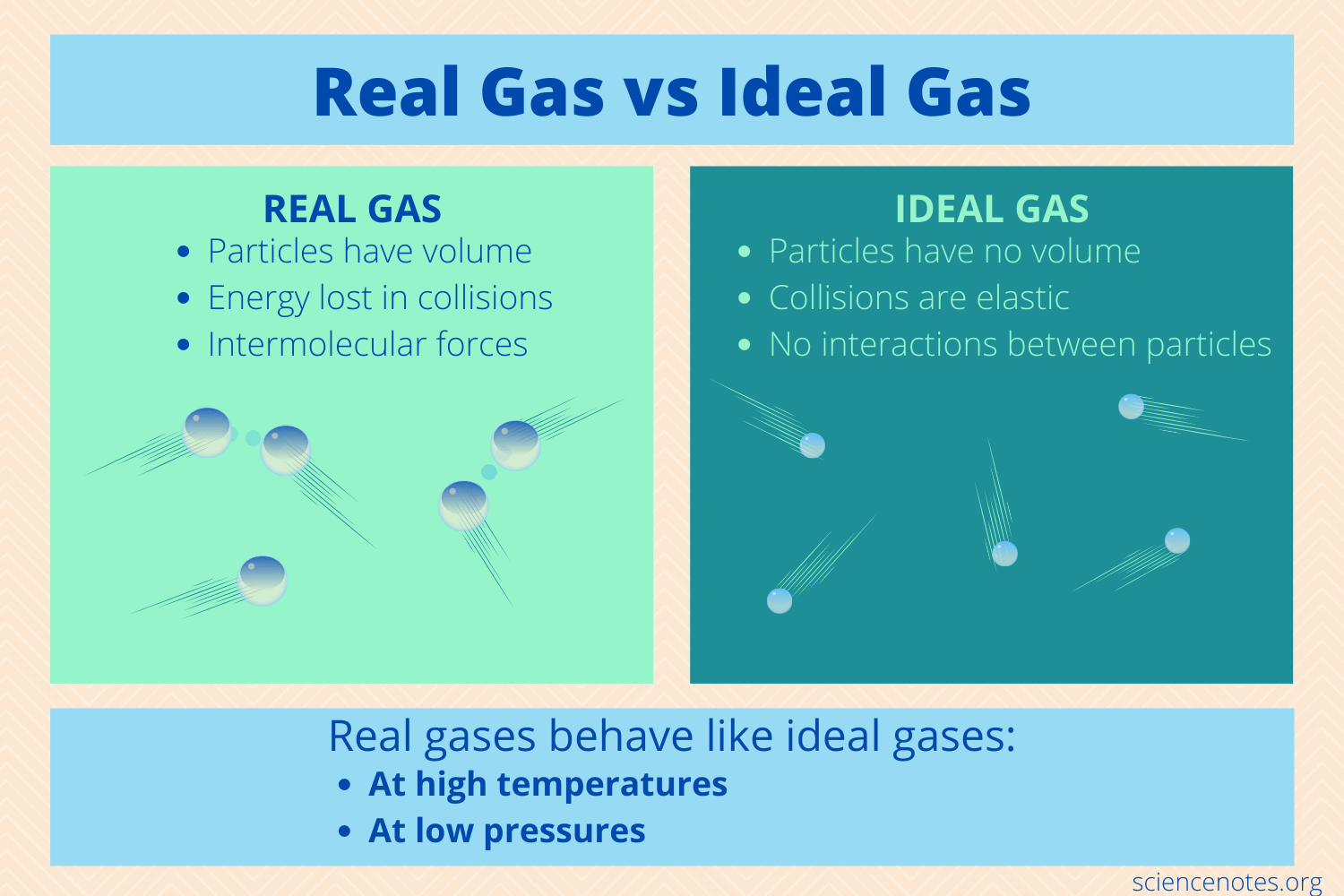
When an ideal gas is assumed, the following formula applies:
PV=nRT
Where P is pressure, V is the volume of the container, n is the amount of moles of the gas, R is the ideal gas constant ≈8.314molKJ.
Derivation
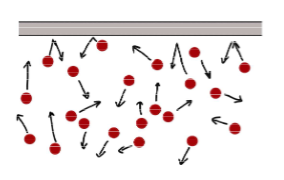
\\ Force\ upward\ on\ surface
\\ = - Force\ on\ molecules
\\ = - Rate\ of\ change\ of\ momentum\ for\ molecules
\\ F = (-\Delta p_z)_{1 \ molecule} * (\# of collisions/second)
\\F = A\frac N V (mv^2)_{AVERAGE}
\end{gather}$$
Where $\Delta p_z$ is the momentum of one molecule, $A$ is the area of the surface the force is applied to, $mv^2$ is the average mass times the average velocity of a particle, $V$ is the volume, $N$ is the amount of particles.
$$\begin{gather} P = \frac 2 3 * \frac N V * (\frac 1 2 m v^2)_{AVERAGE}
\\ P = \frac N V * \frac 2 3 E^{Avg}_{Kin}
\\ P = \frac N V * \frac R {N_A} T
\end{gather} $$
Where $P$ is pressure, $\frac N V$ is the number density, $E_{kin}^{avg}$ is the average kinetic energy of a particle, $R$ is the ideal gas constant, $N_A$ is Avogadro's number, and $T$ is the temperature Kelvin
## ...
negative pressure??
<+desc>
When one of the sides of the tube's pressure is higher the liquid will be lower as the liquid is being pushed down and rising up on the other side. If you have the same amount of liquid on both sides, then the pressure will be the same
Note that if you make the volume smaller, and the number of particles stay the same, the pressure will increase, the liquid will lower and the opposite side will rise of mercury.
P of Hg + gas of the right = P of Hg + gas (atmosphere) of the left
> General manometer equation and diagram
> barometer
## Conductivity

Conduction and convection requires a transmittance medium while radiation does not and can be transferred through a vacuum (e.g. outer space).
## Black Body Radiation !!
- A black body which absorbs all incident electromagnetic radiation is both the perfect absorber and the perfect emitter of radiation.
- The radiation emitted by such a body at constant temperature is called black-body radiation.
- The Stefan-Boltzmann law states that the power of radiation emitted by a black body per unit area is proportional to the fourth power of its temperature.$$P = e\sigma A(T^4-T^4_c)$$ Where $P$ is the radiated power, $A$ is the radiating area, $\sigma$ is Stephen-Boltzmann constant, $\approx 5.6703 \times 10^{-8} \frac {W}{m^2K^4}$, $e$ is the emissivity (=1 for an ideal black body that absorbs all light), $T$ is the temperature of the radiator, $T_c$ is the temperature of the surroundings.
... ?
![[images.png]]
...
$$S(\lambda) = \frac {2\pi c^2h}{\lambda ^5}\frac1{e^\frac{hc}{\lambda k T}-1}$$
...
### Albedo and Emissivity
**Albedo**
- The Albedo (α) of a planet is defined as the ratio between the total scattered (reflected) radiation and the total incident radiation of that planet.
- Albedo = total scattered power / total incident power
- The albedo of a planet is affected by the following:
1. Season (cloud formations)
2. Latitude
3. Terrain (ocean has low albedo because it mainly absorbs and snow has high albedo because it mainly reflects)
- The global annual mean albedo is about 0.3 (30%) on Earth.
**Emissivity**
- Most objects are not black bodies. They radiate a fraction of the power per unit area compared to a black body at the same temperature. The value of this fraction depends on the object and is called the object’s emissivity (e).
- Emissivity = power per unit area radiated by the object / power per unit area radiated by a black body at the same temperature.
- The equation for the power radiated by an object with emissivity e can be given by the diagram in the previous section (Black-body radiation).
- The solar constant
- The solar constant is the amount of energy that normally falls on a unit area (1m^2) of the Earth’s atmosphere per second when the Earth is at its mean distance from the sun.
- The solar constant is approximately 1366 W/m^2.
![[emis.png]]
### Greenhouse Effect
Greenhouse gases:
- Greenhouse gases absorb infrared radiation because its molecules have natural frequencies in the infrared region and readily absorb infrared radiation due to resonance.
![[reyrtyrt.jpg]]
Mechanism:
1. Incoming radiation from the sun takes form of ultraviolet and visible radiation.
2. Some of this radiation is absorbed by the Earth’s atmosphere and some of the radiation is reflected back into space by the Earth’s surface (ground).
3. The radiation which is reflected back into space takes form of infrared radiation.
4. The greenhouse gases present in the atmosphere absorb infrared radiation and reflect it back towards the Earth’s surface.
5. Thus, heat energy becomes trapped inside Earth’s atmosphere and accumulates, leading to the greenhouse effect and an increase in average mean temperatures on Earth.
Chain reaction:
- Global warming reduces ice/snow cover. This causes a decrease in albedo and increases the rate of heat absorption by the Earth.
- The solubility of carbon dioxide in the sea decreases with increasing temperature, leading to an increase in atmosphere carbon dioxide (greenhouse gas) concentration.
Effects:
- Rise in mean sea level by the melting of ice on land.
- Extreme weather such as heat waves and heavy floods.
![[ewrewwr.jpg]]
Energy balance in the Earth surface–atmosphere system:
Earth’s energy balance describes how the incoming energy from the sun is used and returned to space. If incoming and outgoing energy are in balance, the Earth’s temperature remains constant.
![[helewoij.jpg]]
## Energy Production
### Specific Energy and Energy Density of Fuel Sources
- Specific energy and energy density are useful measures of the energy that will be released from a given weight or volume of fuel when it is burned.
- Specific energy is the energy per unit mass of the fuel and can be given by energy/mass
- Energy density is the energy per unit volume of a fuel and can be given by energy/volume.
### Sankey Diagrams
**Energy degradation**
- While energy may be completely converted into work in a single process, a cyclical process is required to convert thermal energy to work continuously.
- In accordance with the second law of thermodynamics, some energy will be lost to the surroundings and cannot be used to perform . The unavailable energy is called degraded energy: Useful work
**Sankey diagram**
- A Sankey diagram is a type of energy diagram where the width of each arrow is proportional to the amount of energy in that section.
![[jhijknlklk.gif]]
![[iohoihioljlk.gif]]
### Primary Energy Sources
Primary energy sources are found in nature and have not been subjected to any conversion or transformation process.
![[ijeoiheoi4.png]]![[43oiou.jpg]]
### Electricity as a Secondary and Versatile Form of Energy
Electricity is a secondary and versatile form of energy.
Production of electrical power:
1. Fuel is used to boil water to produce pressurized steam.
2. The pressurized steam drives a turbine which is connected to coils of wire.
3. When the turbine rotates, the coils of wire move through a strong magnetic field. Electrical power is produced via electromagnetic induction in the generator.
![[erm.gif]]
- Renewable and non-renewable energy sources
- There are two categories of primary energy sources: renewable energy resources and non-renewable energy resources.
- Renewable energy sources are the ones which cannot be depleted.
- Non-renewable energy sources can be used up and become depleted.
- Most energy sources derive their energy from the sun directly (e.g. solar power) or indirectly (e.g. fossil fuels).
| Renewable energy sources | Non-renewable energy sources |
| ---------------------------------------------------------------------------------------- | ------------------------------------------- |
| Solar power<br>Wind power<br>Hydroelectric power<br>Tidal power<br>Geothermal<br>Biomass | Oil<br>Natural gas<br>Nuclear power<br>Coal |
## Convection
## Entropy
Entropy is a measurement of order/disorder, a measurement of ‘randomness’ or chaos, or pure information. And can be denoted by $S, \Delta S, S \degree$
### Second Law of Thermodynamics
$$ \Delta S_{universe} = \Delta S_{surroundings} > \varnothing $$
The formula above only applies to the net of the universe as a whole. And the entropy of the universe is always increasing. Whenever a system has become more disordered the entropy increases and $\Delta S$ is positive. ‘Chaos is the inability to discern a pattern.’
- It is possible to decrease entropy (increase order) of a system but in turn the $\Delta S_{surroundings}$ must increase in greater magnitude.
- Entropy is proportional to enthalpy, heating up temperature, $\uparrow\Delta T$ increases entropy.
### Third Law of Thermodynamics
The entropy of a pure crystalline substance at absolute zero, ($0K$) is also. (Absolute zero is purely theoretical - atoms are defined by their vibrations)
- The randomness/entropy decreases as temperature decreases
- Even in a solid, on the same atomic level, there is movement and oscillation.
- This cannot be observed because of a scale issue.
### Entropy and Spontaneity
Knowing enthalpy and entropy can help us determine whether or not a reaction will be spontaneous. Spontaneity is a description of the possibility to occur, without continued external interference (energy or work.) - Self sustaining = spontaneous. A non-spontaneous reaction, would require a constant work done externally to occur. (Constantly needs to be ignited)
Spontaneity had nothing to do with reaction rate/activation energy/speed/sensitivity/volatility of reaction.
A process that is spontaneous in one direction is not spontaneous in the other direction.
- Cell respiration is spontaneous, whereas photosynthesis requires constant work (not spontaneous)
- You can cook an egg to where it is spontaneous and self sustaining, then it is theoretically possible to ‘uncook’ that egg with enough constant energy/work.
### Quantitative changes in enthalpy
$S^{\Theta}$ = Entropy of one mole of a substance at standard conditions. The units of which are$J/mol \degree K$
$$ \Delta S \degree _{rxn} = \Sigma nS\degree _{products} - \Sigma n S\degree _{reactants} $$
Example: Calculate the $\Delta S \degree$ for the following
$$ Al_2O_{3(s)} + 3H_{2(g)} \rightarrow 2Al_{(s)} + 3H_2O_{(g)} \\ \Delta S _r\degree = [(2)(28)+3(188.8)] - [(1)(51) +(3)(131)] \\ \Delta S_r\degree = 178 J/K $$
### System to System Comparison (Qualitative Changes in Enthalpy I)
Temperature change - since faster molecules are more random.
Phase change - going from solid to gas increase in entropy. ($s <l<aq<g$)
Dissolving - solid → dissolve in water → aq ($\uparrow \Delta S$), gas → dissolve in water → aq ($\downarrow\Delta S$)
Increasing the number of (compare the number of moles of product vs reactants (if 1 mol of $X_2$ produces $2X$, then the $\Delta S$ also increase. As there are more ‘things’ that are moving around)
### Molecule to Molecule Comparison (Qualitative Changes in Enthalpy II)
Entropy change generally increases with mass (’increased complexity) of the particles.
$$ HCl <HBr_{greater \ \Delta S}, O_2 <O_{3\ greater \ \Delta S} $$
When predicting reactions, all the system system reactions are more important than the individual complexities of each molecule.
### Gibbs Free Energy
$$ G=H-TS\\ \Delta G = \Delta H -T\Delta S $$
$\Delta G$ = change in Gibbs free energy, the maximum work that a system can do OR the minimum amount of work must be done. $\Delta H$ = change in enthalpy, $\Delta S$ = change in entropy, $T$ is the temperature, $(K)$ .
- $\Delta G < \varnothing$ = spontaneous reaction
- $\Delta G = \varnothing$ = process at equilibrium
- $\Delta G > \varnothing$ = non-spontaneous reaction
Free energy is a state function - only initial and final conditions matter.
- If a reaction has $\Delta H > |T\Delta S|$ then it is an enthalpy driven reaction. That is to say that if the magnitude of the enthalpy is greater, than it has more influence in the reaction. Meaning that the reaction likely happed as a result of enthalpy rather than entropy
- If a reaction has $\Delta H <|T\Delta S|$ then it is an entropy driven reaction. That is to say that the magnitude of the entropy is greater than the enthalpy. Meaning that the reaction more likely happened as a result of entropy rather than enthalpy.
### Types of reactions:
- $\Delta H <0$ (exothermic), $\Delta S >0$ (messy) → Spontaneous at all temperatures
- $\Delta H > 0$ (endothermic), $\Delta S <0$ (tidy) → Non-spontaneous at all temperatures
- $\Delta H <0$ (exothermic), $\Delta S <0$ (tidy) → Spontaneous at “low” temperatures
- $\Delta H > 0$ (endothermic), $\Delta S>0$ (messy) → Spontaneous at high temperatures
### Standard Free Energy of Formation ($\Delta G_f\degree)$
$$ \Delta G_r \degree = \Sigma n \Delta G_f \degree _{products} - \Sigma n \Delta G_f \degree _{reactants} $$
Note that the standard free energy for formation of an element is 0.
### Example of a Standard Free Gibb question:
$$ 2CO_{(g)} +O_{2(g)} \rightarrow 2CO_{2(g)} \\ \Delta G _r \degree = (2mol) (-394.4kJ/mol)-(2mol)(-137.2kJ/mol) \\ =-514.4kJ $$
Since $\Delta G_r\degree <0$, this reaction is spontaneous.
 Molecules are held together by intermolecular forces.
The fourth state of plasma is not required to be learned in the current syllabus.
Molecules are held together by intermolecular forces.
The fourth state of plasma is not required to be learned in the current syllabus.