2024-09-2711:45 Status:PHYS106 Tags: Kinematics
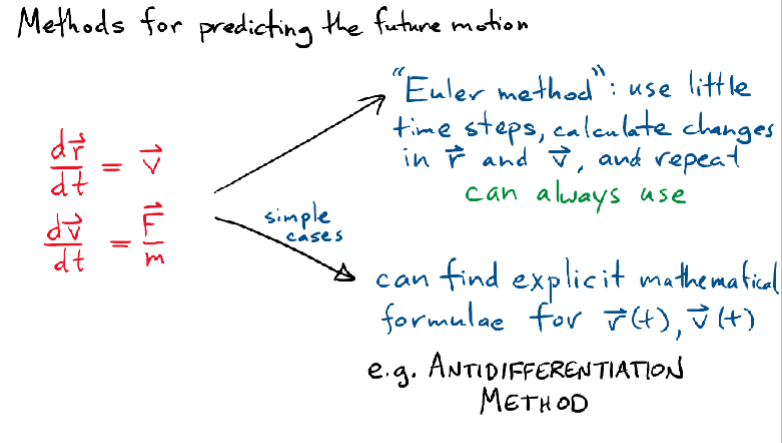
We can use small time steps method to make predictions: https://scratch/mit/edu/projects/576886731/editor
Antidifferentiation method
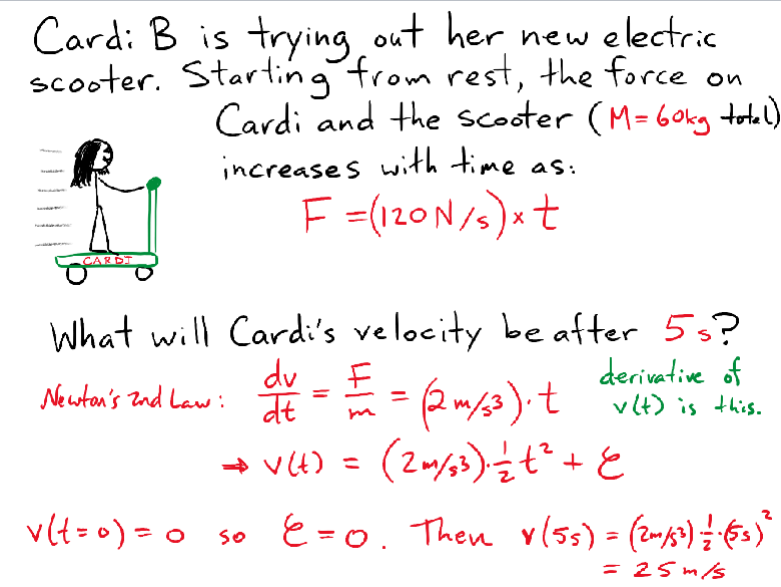
This method can be used to find and explicitly if is a known function of time: If force is a known function of time, , then . To find given , find a function whose derivative is . Then . Choose the number so that the velocity at .
If force is a known function of time, . To find given ): Find a function whose derivative is . Then . Choose the correct number so that the velocity at is correct. Use the same procedure to find given and . I.e. .
Note: constant acceleration is when is constant: . Thus, . Moreover, . This can be derived by remembering the relationship between and its integral, and its derivative/integral, and and its integral (or antidifferentiation). And that Note that can be substituted for “velocity”. Which has the same general formula. This nesting substitution can go on until there is a constant rate.
Example