2024-05-2223:32 Status: Incomplete - Sutori timeline. Tags: Nazism
Weimar Republic
In 1991, immediately after WWI, Germany enacted a new constitution and was for the first time in its history - a republic with modern, liberal democratic structure. The Reichstag, German Parliament, was to be elected by universal suffrage. This government would soon be known as the Weimar Republic because it was in the city of Weimar where the constitution was drafted.
Treaty of Versailles
The conditions of losing WWI detailed that Germany had to:
- “War guilt clause” = admit their complete fault.
- Pay reparations of $33billion USD
- Demilitarized Rhineland
- Limited army and navy
- No air force, tanks, subs etc.
- Give up colonies.
The liberal democratic Weimar Republic had no choice but to sign the Treaty, and many Germans blamed the government for the humiliation and economic hardship the treaty will cause for years. (The big four: Great Brit., US, France, Italy were forced to sign AKA November Criminals). By 1923, hyperinflation has resulted in Germany with the printing of too much money and the Weimar Republic declared it could not continue to pay reparations. (1USD = 4,200billion mark).
In 1923 - Munich Putsch - Hitler tried to overthrow the Weimar Republic by force and failed. He ended in jail, where he wrote his famous fascist doctrine - Mein Kampf (My Struggle) & Hyperinflation.
American banks will step in with the Dawes Plan and Germany will become economically stable until the 1929 Stock Market Crash. Adolf Hitler and the Nazi Party (Nationalist Socialist German Worker’s Party) will take advantage of the economic instability and rise to power.
Hitler’s Rise to Power
Hitler joined the Nazi Party in 1919 and became leader of the Nazi Party by 1921. Hitler promoted absolute nationalism, which called for the unification of all German-speaking peoples. This Nazi nationalism appealed to many Germans because of their history of Germany states. Germany also had a long military tradition (i.e. Prussia). The Nazi’s advocacy of power and stability to many who were tired of the instability of the last few decades. Political violence instigated by the Nazi Party’s paramilitary - into the depression (1930s). - As the Great Depression does not resolve itself.
*Offering the strong leader that will carry Germany back into an empire.
Although The Nazi party’s rise to power was gradual, it was democratic. Hitler became Chancellor of Germany on January 30, 1933. After a fire that was started in the Reichstag on February 27, 1933, a quick election was held. Once the Nazis won the election, Hitler passed the Enabling Act to wipe out all opposition and many individual rights and freedoms. Thereby creating a legal dictatorship where Hitler could instill the principles of Nazism Under Hitler’s rule, no one was safe. In June-July 1934, he eliminated many high ranking SA officers in a purge known as the Night of the Long Knives. With President Paul von Hindenburg’s death on August 19th, 1934, Hitler declared himself Fuhrer, leader of Germany.
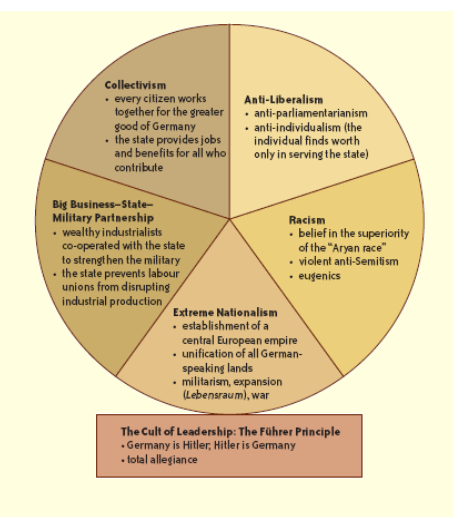
Nazism and the German Economy:
Under the Nazis, the German economy started to grow and prosper (the unemployment rate - 1932=6 million vs. 1936=<1million). Many measures were taken to ensure that autarky (self-sufficiency or independence from other nations) was achieved. Measures such as re-arming of the military, farming and industries were given subsides, imports were restricted etc. However, under Nazism, German workers had few rights and no legal means to protest against them and the German economy was closely monitored.
Hitler in Power
He implemented Propaganda & Cult of Personality, youth movements, elimination of his opposition, the use of Fear and Terror (The SS, Gestapo), Directing Popular Discontent (Scapegoating) (Jewish population, Weimar Republic, communism). All of which encouraged the rejection of liberal values.
Nazism’s Racial Superiority and Scapegoats
Nazi ideology included a racial theory that claimed that Germans formed a superior “Aryan race”. This claimed that various scapegoats (Jewish population, Roma people (Gypsies), Polish people, people with mental and physical disabilities, homosexuals, anyone who opposed fascism, communists, feminists, democratic socialists etc.) were the source of Germany’s problems. In doing so, enforcing eugenics (that is controlling the human population to reduced undesirable traits). In total, an estimated 9-11 million people, including 6 million Jewish people, were killed as supposed sub-humans. This was despite the fact that Jewish people made up less than 1% of the population of Germany. Eugenics
Live of Aryan Germans
Hitler’s manipulation of the German people’s minds was on a mass scale. Annual rallies at Nuremberg, book burnings, government programs loaning newlyweds money and encouraging reproduction with 250 marks per child, women receiving gold medals if she had more than eight = all means by which the German government promoted the Aryan population. The youth were especially targeted by the Reich - Hitler Youth. They also sterilized, castrated, and performed hemispherectomies people who were not Aryan - forced to not reproduced; adding onto the genocide occurring.