2024-09-2421:06 Status:PHYS106 Tags: Kinematics
Alternative Definitions of Newton’s Second Law
Newton’s Second Law: the rate of change of momentum is equal to the net force on that object: . A more familiar version would be: . However, the most useful formulation is: Newton’s 2nd law: Where we must calculate this from and knowledge of the environment. This gives us the definition of velocity (by cancelling ): . In other words,
- The rate of change of position is equal to the velocity
- The rate of change of velocity is equal to the force over mass (force can be calculated from position, velocity and knowledge of the environment) (This is true for each component)
In a small amount of time :
- Position changes by where is the rate of change of position:
- Velocity changes by where is the rate of change of velocity We can predict the future from present :
Predicting the Future
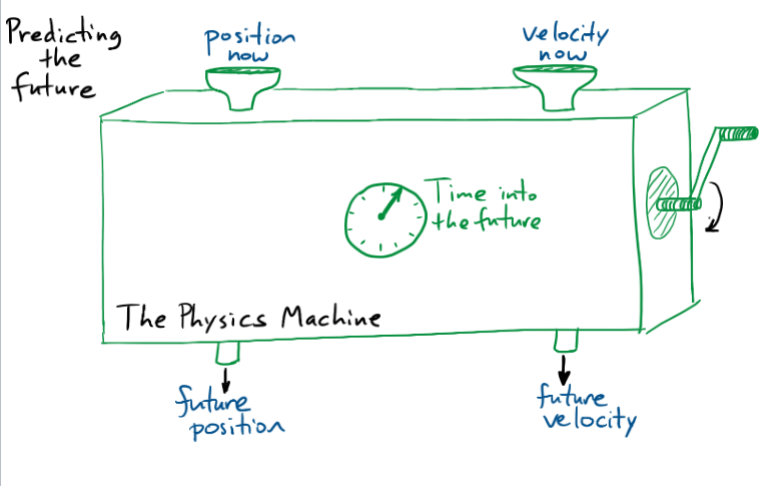
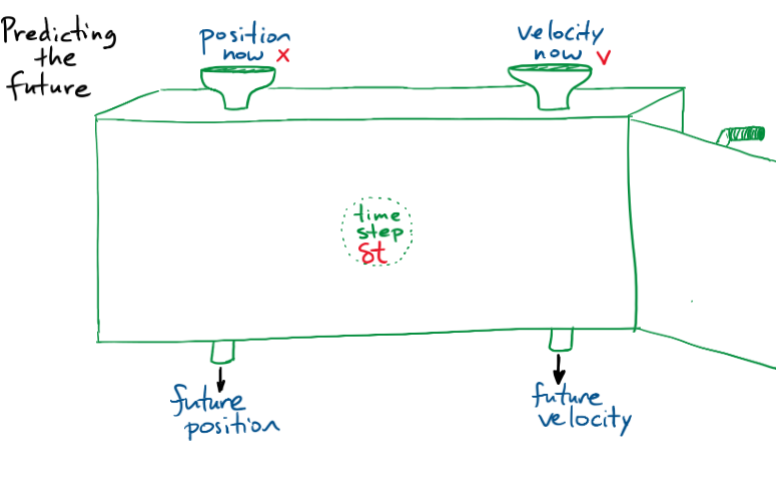
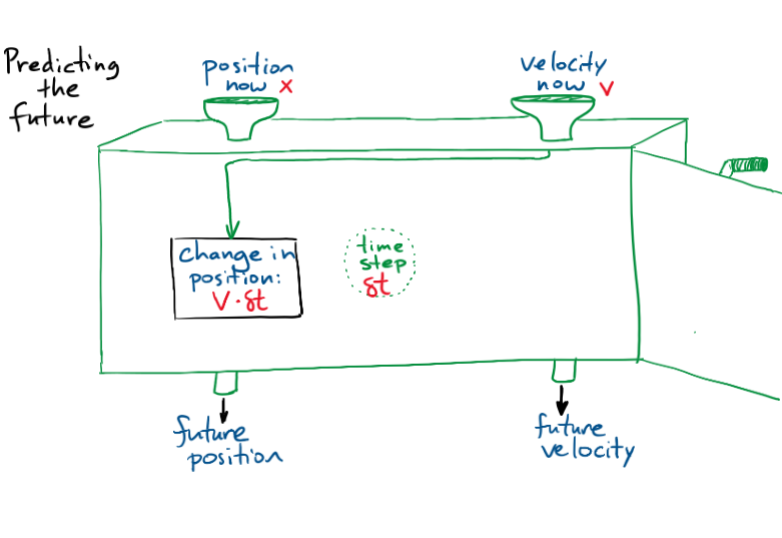
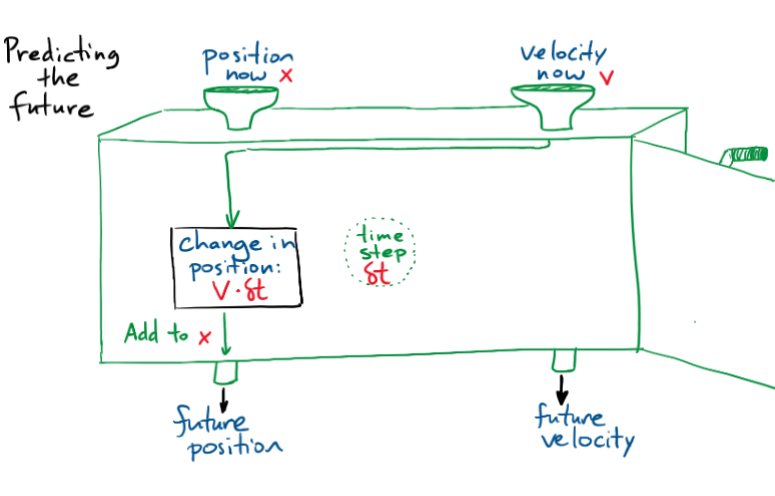
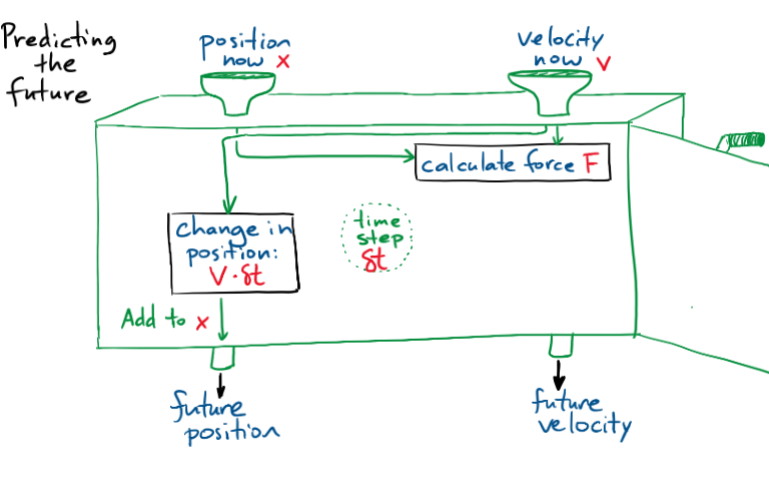
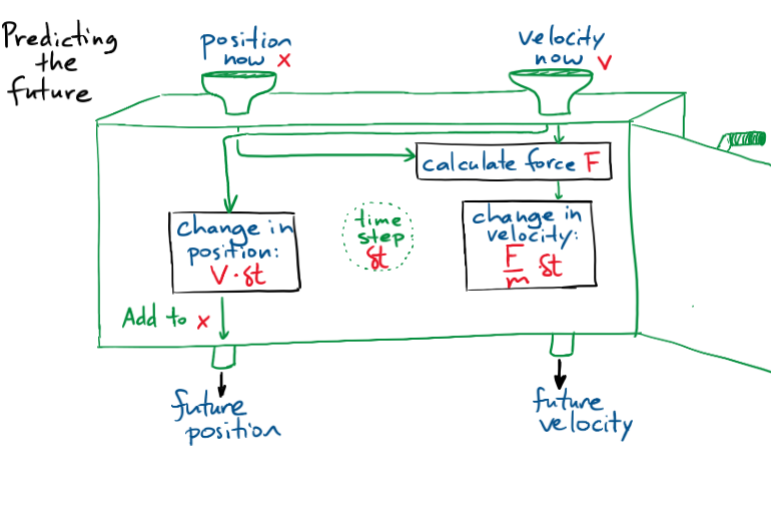
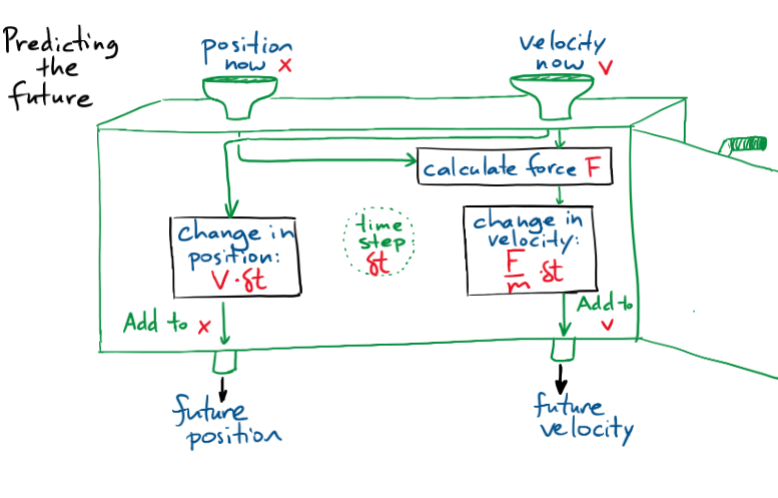
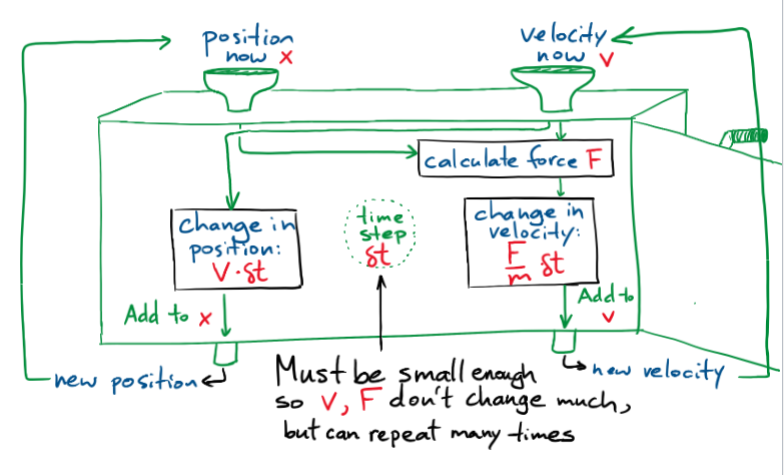
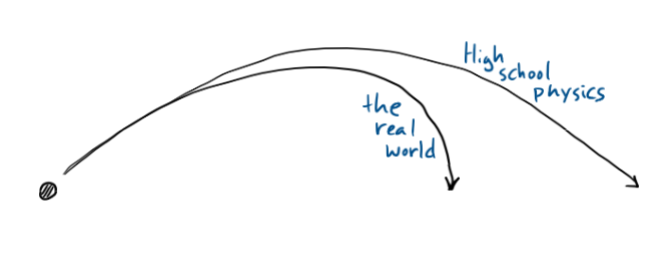
Example: Projectile Motion with Air Drag (Air Resistance)
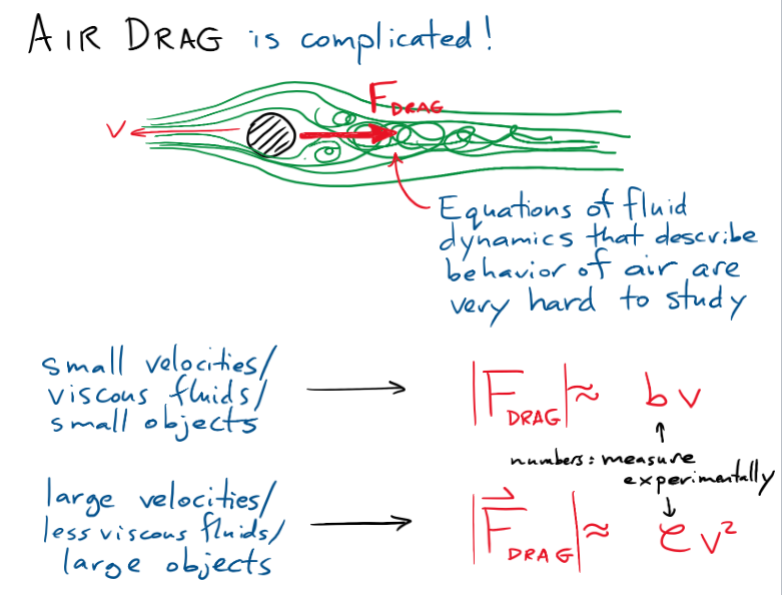
https://www.youtube.com/watch?v=pW0JfEBE9h8 = “Dynamics and Control of Flow around Circular Cylinder” - This is very complicated so we will use the following approximation (objects of low velocity, size, + depends on viscosity - Reynold’s number).
For small velocities, viscous fluids, and small objects use: For large velocities, less viscous fluids, and large objects use: Where and are numbers: measured experimentally and is the velocity
| Time | Position x | Velocity v | Force F |
|---|---|---|---|
| 0 s | 2 m | 3 m/s | - 1.5 N |
| 0.1 s | 2.3 m | 2.95 m/s (3m/s + (-1.5N / 3kg) * 0.1s) | //////// |
| 0.2 s | … | ||
| Doing this process by hand is very laborious, so computers often do this, | |||
| https://www.youtube.com/watch?v=GMmNKUlXXDs&t=1s |