Electricity
Charge
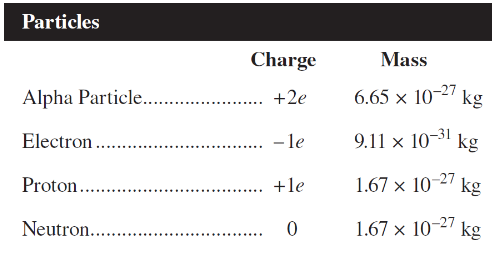
Matter is composed of atoms which are made of electron, protons and neutrons. Moreover, protons carry a positive charge while electrons carry a negative charge of the same magnitude being the elementary charge (neutrons carry no charge). Protons are fixed to their nucleus whereas electrons are free to travel more freely. Electrons have approximately 1/2000th of the charge that protons carry. Atoms found in their ‘natural state’ have a charge of zero, however if an atom becomes ionized, it can have ‘an extra charge’.
TLDR: Electrons positive, Protons negative and have the same magnitude of charge, on formula sheet
Conductors and Insulators
Electrical conductivity depends on how tightly electrons are bound to the nucleus of an atom. Insulators have electrons that are tightly bound to the nucleus and are not free to travel within the substance. Materials that have electrons on the outermost regions of the atom that are free to travel are conductors.
- Insulator examples: Ebonite (plastic), glass, rubber, pure/distilled H2O
- Conductor examples: Metals, graphite, salt solutions, people, ionized H2O
Law of Charges; Conservation of Charges
Like charges repel, unalike charges attract (Note: If a particle is neutral, it will still be attracted to any charge particle - definition includes this case). The net charge of an isolated system is conserved.
Measuring Charge
The SI unit of charge is a coulomb, C having a symbol of ‘q’.
1 C of negative charge is equivalent to the charge of 6.25*10^18 electrons. The same magnitude applies to protons.
Methods of Charging Objects:
Charging by Friction
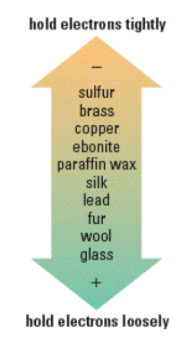
When materials are rubbed together, electrons can transfer from the material that holds it electrons loosely to a material that holds onto the electrons tightly -charge is conserved. Ex. charging ebonite using fur, the negative charge gained (negative lost) by the fur. Additionally, it produces oppositely charged objects.
The larger the difference of how tightly an electron is held on to by a given material correlates to how easily electron transfer can occur via charging objects by friction.
Charging by Conduction
Objects can become charged by the transfer of electrons from a charged object to an uncharged object by simply touching the objects together. This produces similarly charged objects. If conductors of different sizes are touched together, the object with the larger surface area takes more charge. The voltage will equalize.
Charging by Induction
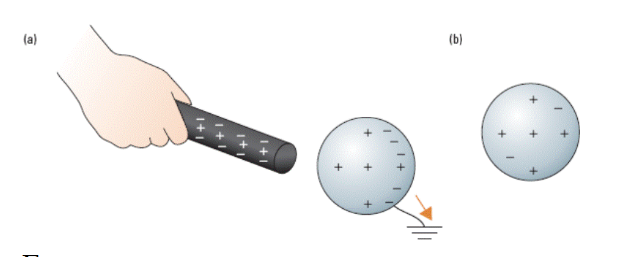
Induction is a process in which charges in a neutral object shift or migrate because of the presence of an external charged object. This temporary charge separation polarizes the neutral object. One side of the object becomes positively charged and the other side is equally negatively charged.
In order for an object to retain its charge through induction, a path for the electrons to leave the object must be provided. Negative rod is brought near the grounded conductor; ground is removed, negative rod is removed. This will produce a charged object using induction.
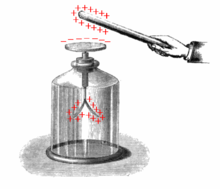
Electroscopes
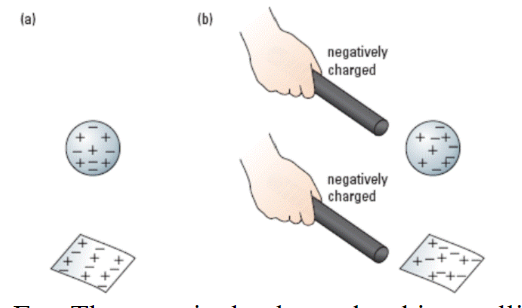
Whenever a negatively charged object such as a negatively charged rod is brought near a neutral electroscope, the negative charges in the electroscopes are repelled away from the rod. Making the ‘top’ of the electroscope have a positive net charge. Generally, electroscopes show the presence of charge within an object.
Coulomb’s Law
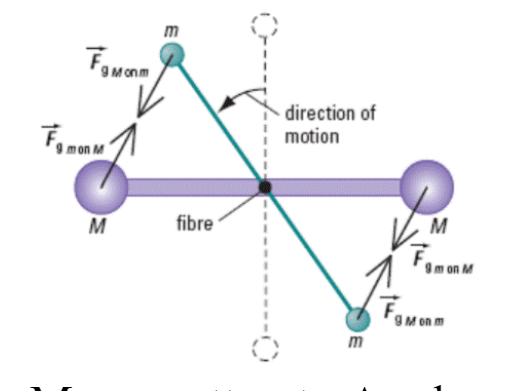
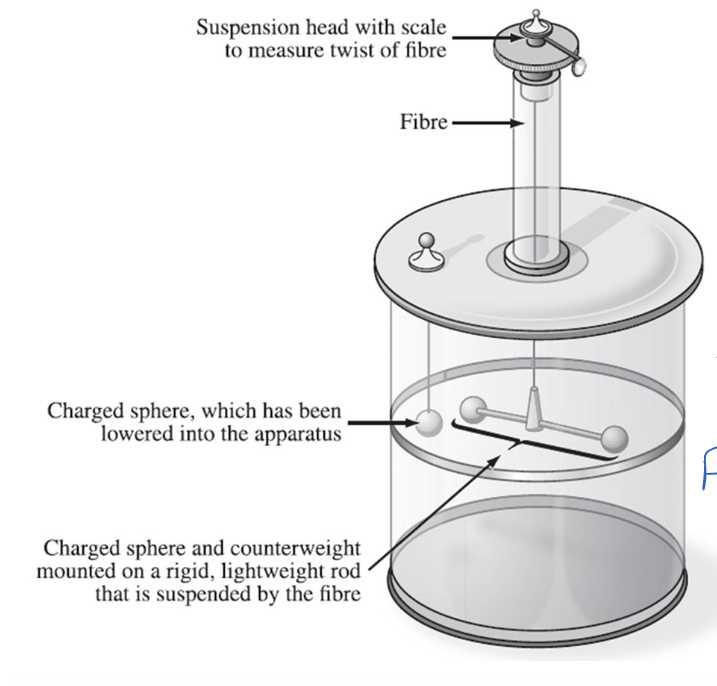
Coulomb’s law is used to measure to electrostatic force between two point charges. This was determined through the usage of a torsion balance similar to Cavendish’s model when investigating gravitational force between two masses. The following equation was determined by determining the proportionality given constant variables:
Where electrostatic force, ., Coulomb’s constant, , charges of the spheres (point charges) , , distance between centres of spheres,
1D questions and 2D questions are often asked. If asking to determine the electrostatic force on a sphere on a plane, use vectors to determine
Arcing:
If electrical charge present in an object becomes significant enough, it can pass through the air and force it to act as a conductor would. This process is ‘arcing’. This is an example of conduction not induction as electrical charge actually transfers from one object to another.
Electric charge can either be positive or negative. Charges with the same sign repel each other and changes with the opposite sign attract.
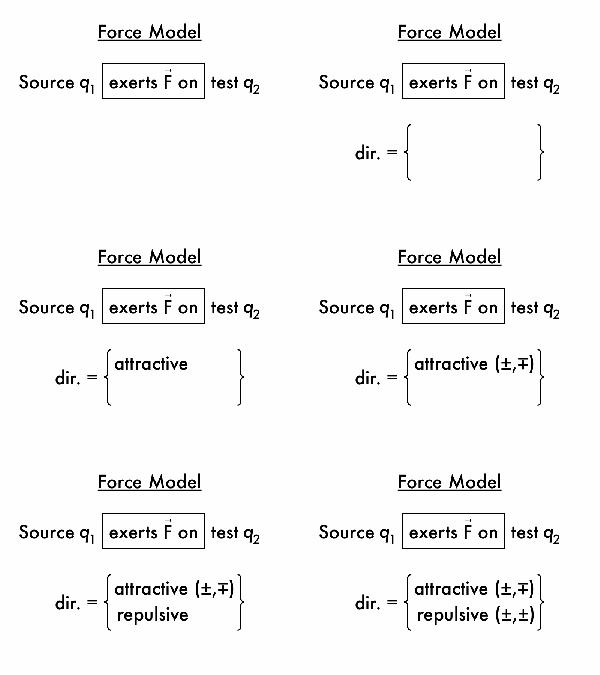
An object with equal amounts of positive change and negative charge is said to be electrically neutral. The unit of electric charge is coulomb (C). The charge of one electron is equal to 1.6*10^-19C. Electric charge is always conserved. While charges could migrate from one body to another, the total charge remains the same.
Conductors are materials which allow the passage of electric charge. This is due to the presence of free electrons in solid conductors.
- Examples of conductors include all metals, graphite, humans. Insulators are materials which do not allow the passage of electric charge.
- Examples of insulators include wood, glass, and plastic buckets.
Electric Field
Similarly to how masses have gravitational fields, charges have electromagnetic fields. Electric field intensity, is the ratio of the force an electric field puts on a positive test charge over the size of a test charge, . Where a test charge is a point charge whose charge is small enough to not affect the field its placed in. The SI units of electric field intensity are measured in N/C. **Not a kind of Energy. The direction of the magnetic field is drawn such that it reflects the direction of force on a positive charge when placed in an object’s magnetic field.
When the formula for electric field strength is combined with the formula for electrostatic force on an object, the following formula is formed. (One of the point charges cancels out
Drawing field lines:
As mentioned earlier, field lines are drawn towards the negatively charged point/area. Using this the following diagrams are made:
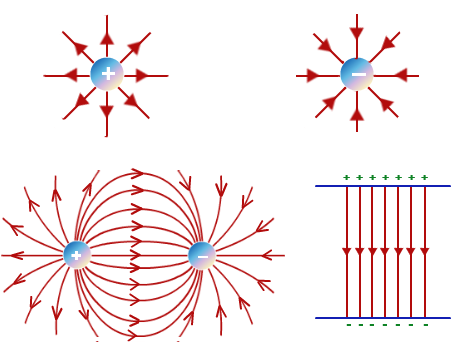
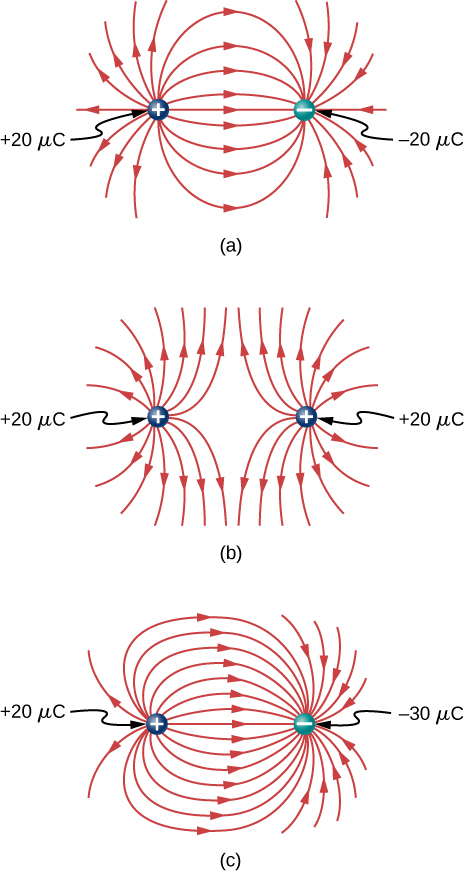
Electric fields can be graphically represented as electric field lines.
- The direction of the field at a point is equal to the direction of the field line passing through that point (arrows from the positive pole to the negative pole).
- The magnitude of the field at a point corresponds to the density of the field lines around that point. For a uniform electric field, the field lines are straight, parallel and equally spaced.
Non-uniform electric field
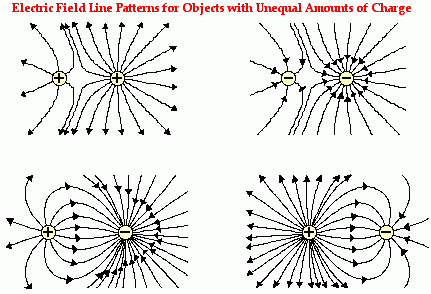
Uniform Electric Field
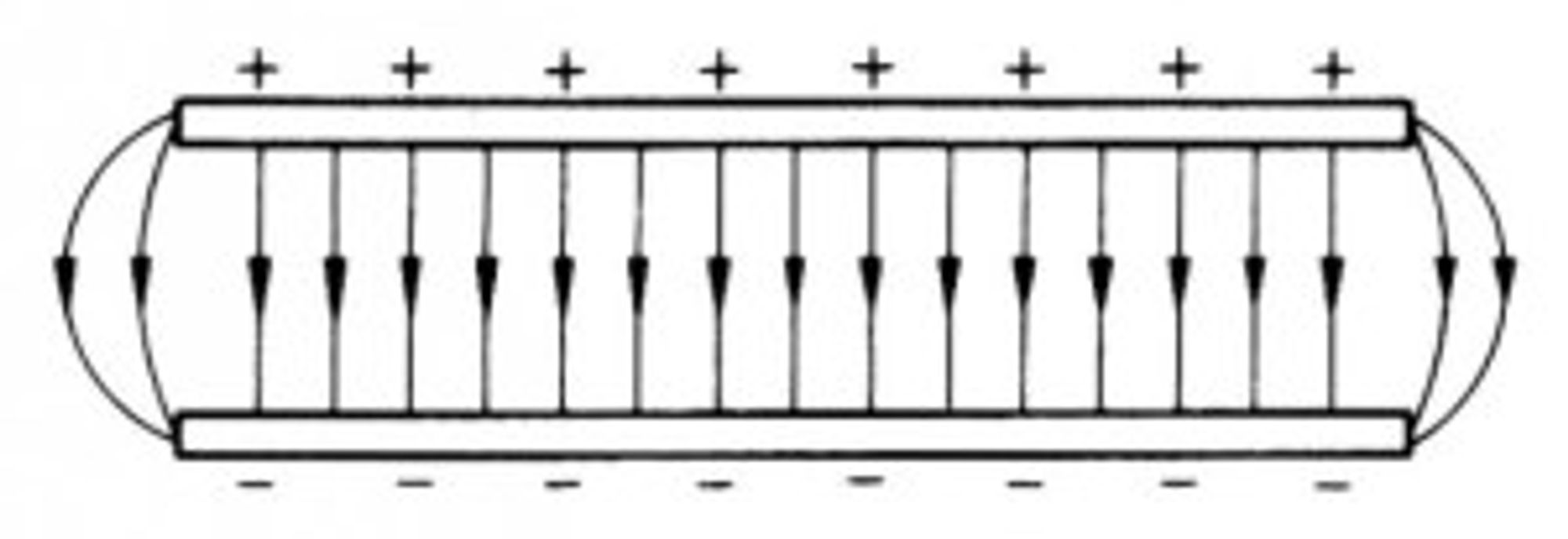
The electric field lines curve outwards near the edge of the plates. This is known as the “edge effect”. Electric field strength (E) is the force per unit charge experienced by a positive test change placed in a field.
To describe the attraction between two charged particles Coulomb’s Law is used: Where () is the force, is , and () are the charge of the two objects (usually the same when considering two electrons), and is the radius/distance between the two charges ().
Therefore, since we can deduce that for non-uniform electric fields, the electric field strength can be calculated by
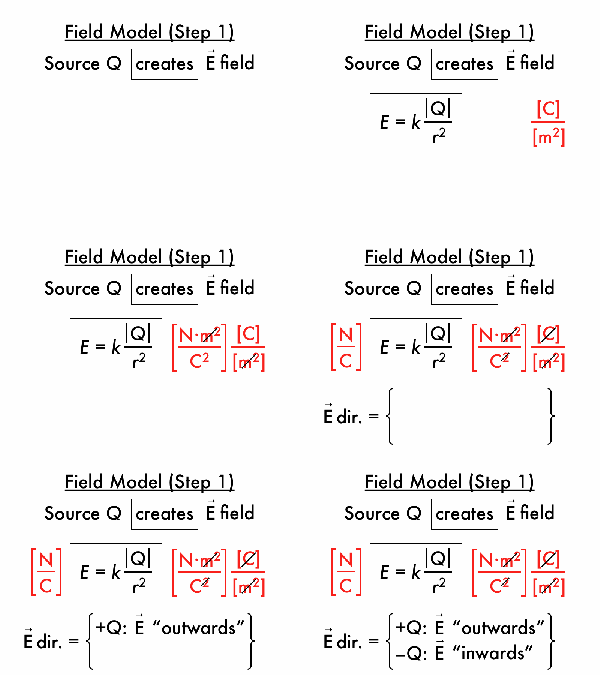
by cancelling out q (charge) on both sides.
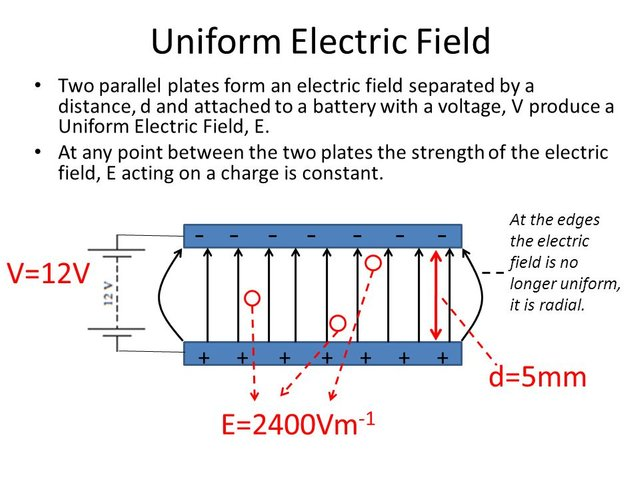
For uniform electric fields, the electric field strength can be calculated by:
Special Situations
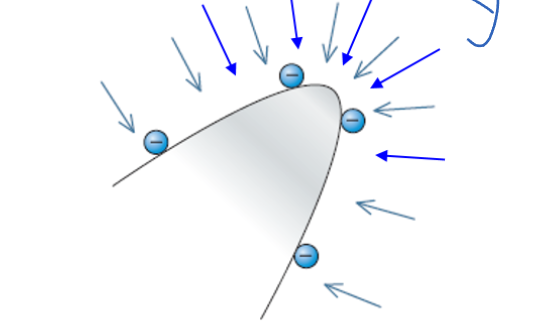
Around an irregularly shaped conductor, the magnetic field strength at a ‘sharp’ point is greater than the surrounding field strength of the object.:
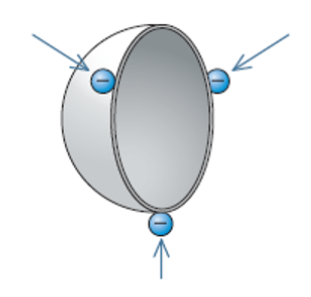
Inside a hollow conductor, there is no electrostatic field present.
For parallel plates, the Electric field strength is constant at all points inside the plates. **Electric field wraps around the plates which is not depicted in the diagram.
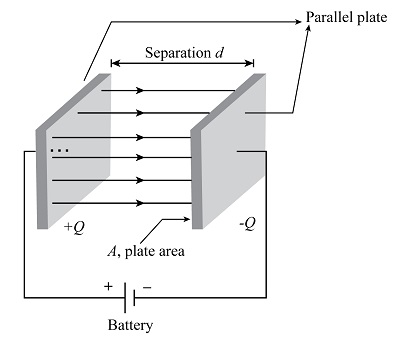
In order to suspend a charge in an electric field, there would need to be an equal but opposite electrostatic force to counteract the gravitational force downwards. This can be done only because there is an average/constant/uniform electrostatic field
There are also Parallel plate questions involving voltage and distance + parabolic motion.
Voltage
Electrical Potential Difference
Similarly to how and object has gravitational potential energy when their above the surface of a much larger mass, measures gravitational potential energy/unit mass, point charges act similarly; as when work is done to move the smaller positive charge away from the object against the conservative electrostatic force, the work done increases the electrical potential energy.
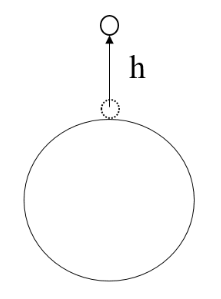
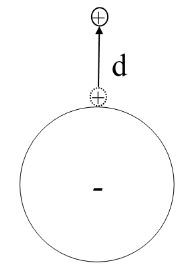
Electric potential difference (AKA electrical potential difference, potential difference or potential) is the change in electric potential energy per unit charge, measured in voltage, , SI units: The electric potential difference (pd) between two points is equal to the work done (energy) required per unit charge to move from one point to another. It is also known as voltage (V).
Charged Particle in an Electrical Field
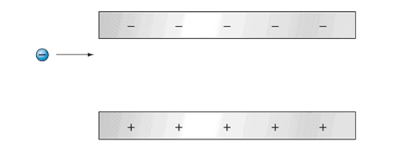
If charged particles can move freely in an electric field, the electric potential energy can be converted to kinetic energy of the moving particle. Note: For small particles such as electrons and protons, the space they move in must be evacuated from air, as air particles would collide with the moving charged particles and rob them of their kinetic energy.
Electron volts: An electron volt (eV) is the quantity of energy an electron gains or loses when passing through a potential difference of exactly 1V. One electron volt is significantly smaller then one joule.
Where = electric field, = voltage, = displacement, =point charge = work, change in energy.
Parabolic motion of a charged point
**Use kinematics formulas + new ones together AND don’t forget
Current
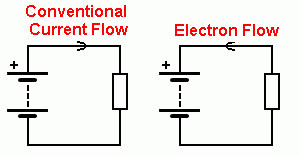
The existence of an electric potential difference (see the last section of 5.1) across an object causes charges to flow through the object. Electric current (I) refers to the rate of flow of electric charge and can be given by the equation: Where is the current, is the total charge, and is the time taken. The direction of an (conventional) electric current is opposite to the direction of electron flow.
Direct Current (DC)
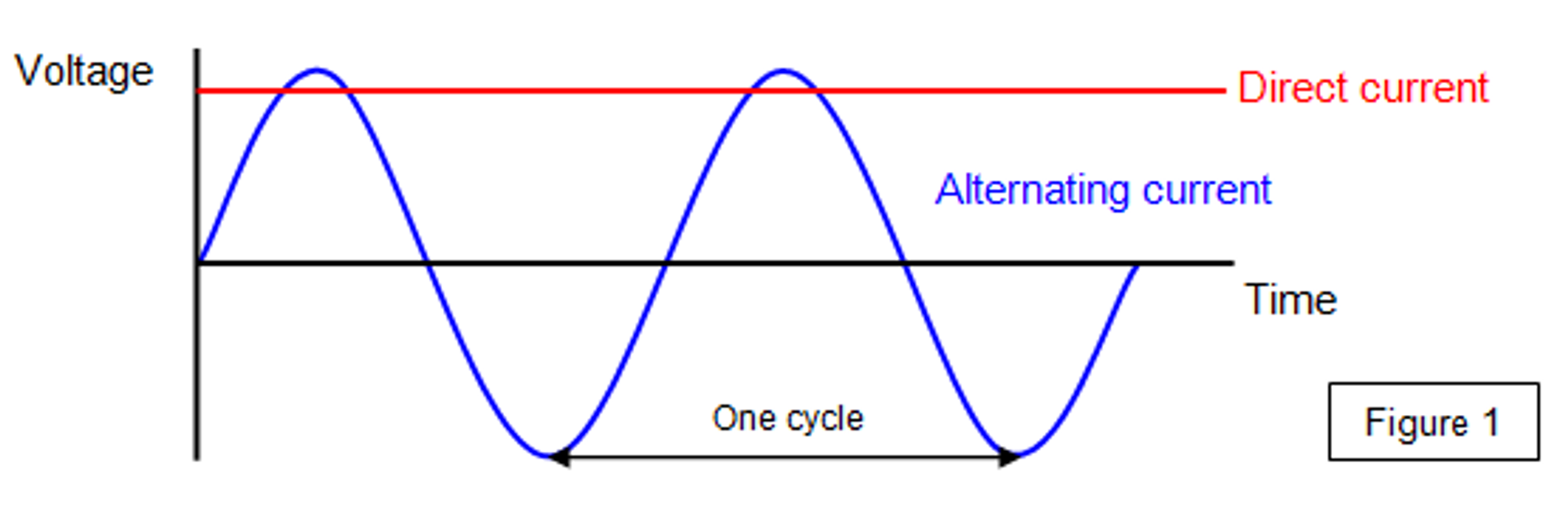
Direct current (DC) is a uniform current flowing in one fixed direction in a circuit. Direct current is usually supplied by acid-based batteries or dry cells.