Nature of Light
The wave-behavior of light was found to be a transverse of oscillating electric and magnetic fields. All electromagnetic radiation (EMR). All EMR in a vacuum travels at the speed of light, .
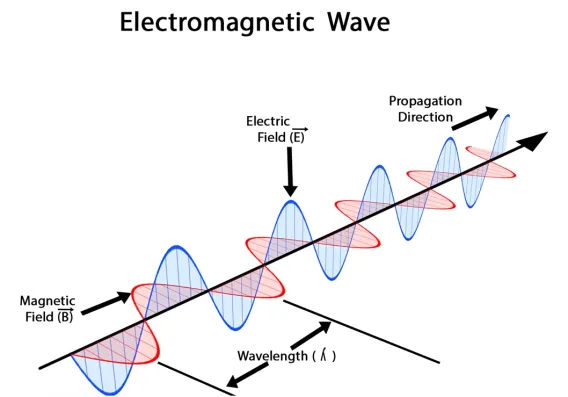
Maxwell’s properties:
- EMR waves are produced whenever electric charges are accelerated. The accelerated charged lose energy that is carried away in EMR waves.
- if the electric charge is accelerated in periodic motion, the frequency of said motion is also the frequency of the EMR emitted.
- EMR consists of oscillating electric and magnetic waves in constant phase relation; they are both perpendicular to each other as well as perpendicular to the wave’s propagation
- All EMR travels at the speed of light, and obey the equation where is the frequency of the wave, and is the wavelength.
- EMR waves exhibit properties of reflection, diffraction, interference, refraction and polarization (polarization is evidence that EMR is transverse)
Heinrich Hertz:
Hertz was the first person to intentionally produce and detect EMR. This was done by using an induction coil to produce a spark across a gap. Hertz was able to detect a spark jumping across the same type of gap on a wire across the room. - The receiver must be in the same orientation as the transmitter and the light is polarized in the orientation of the receiver.
image
The changing electric field produced by the spark between the gap points created an EMR wave that travelled across the room to the open gap. When the wave arrived at the other loop, the changing magnetic field in the wave induced a spark across the second gap because of the strong electric field induced.
EMR properties:
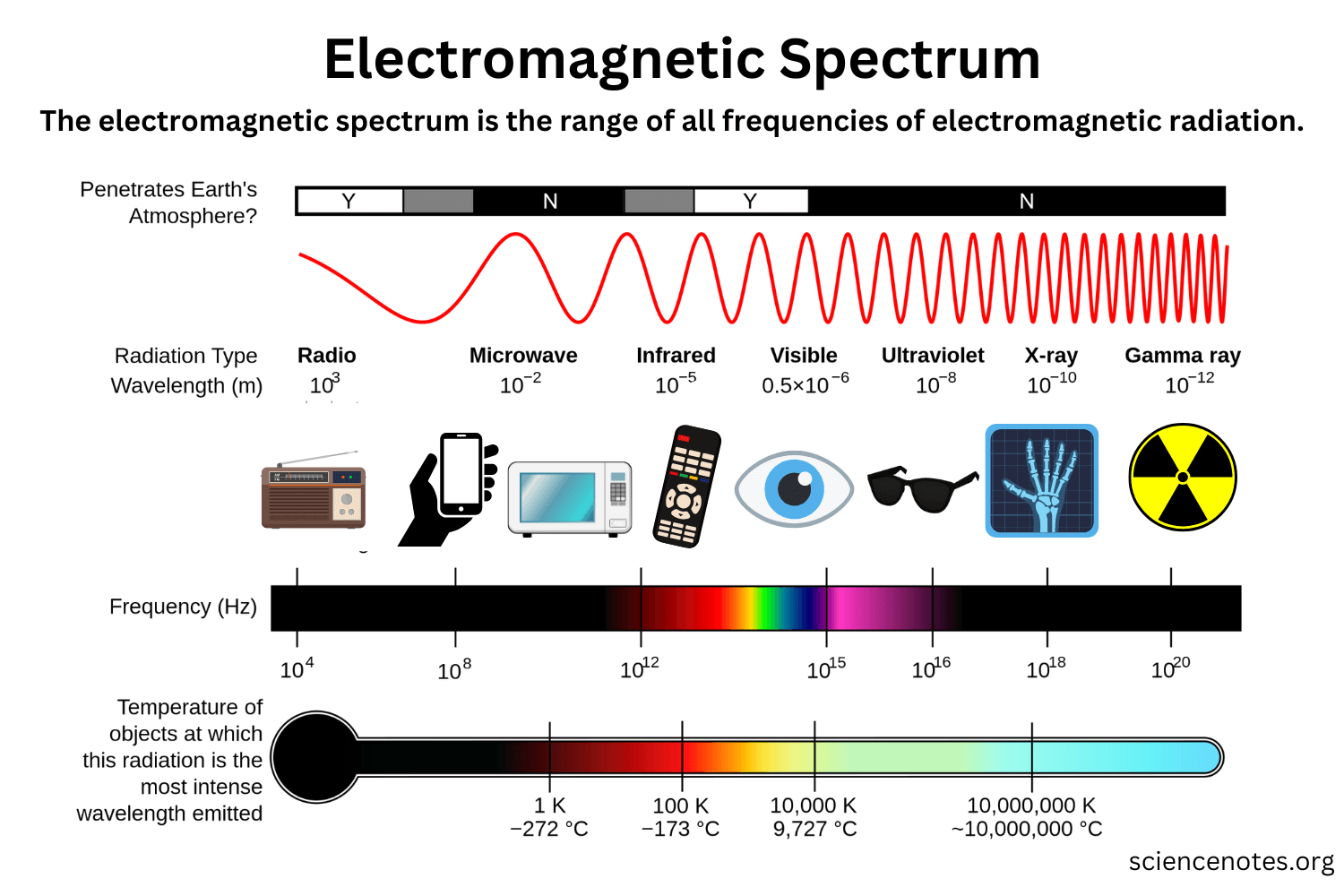
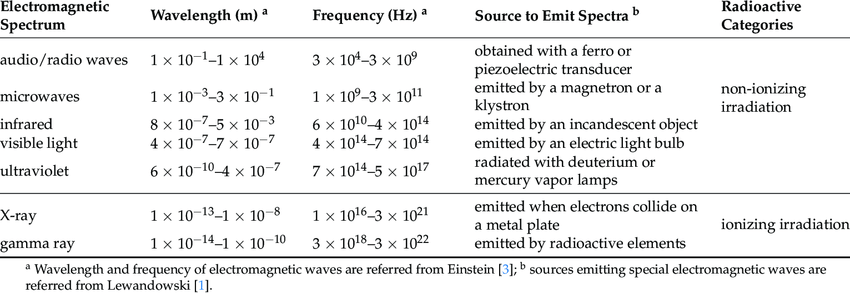
Electromagnetic Induction
Optics !!
Diffraction Grating
Continuous Spectrum of Light
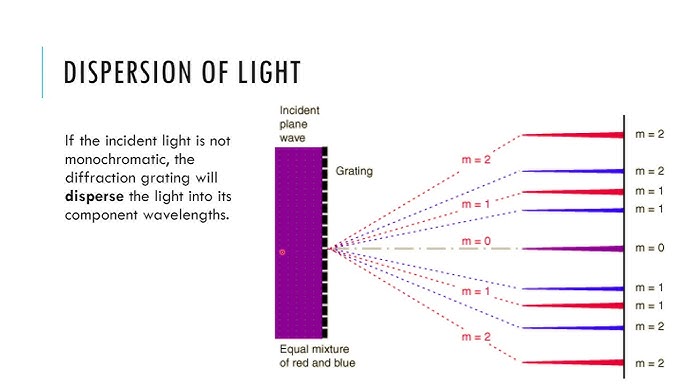
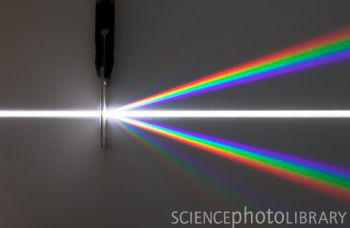
When white light is passed through a prism, we see a rainbow of visible light. The incident light is dispersed by refraction, changing the angle at which each component wavelength exists the prism.
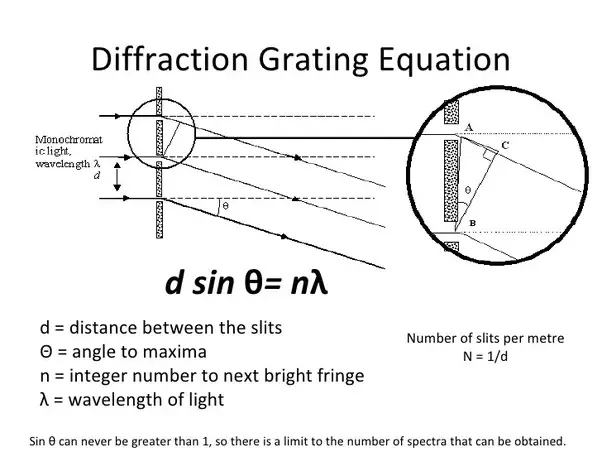
A diffraction grating is the tool of choice for separating the colors in incident light. They separate light because they have a microscopic groove structure that splits incident light into multiple beam paths though diffraction, which in turn causes the light to be refracted at different angles (as each has a wavelength has a different refraction index).

Note that violet disperses the least as per Snell’s law
Thin Film Interference
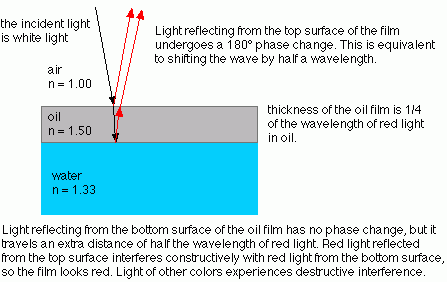
Interference between light waves is the reason that thin films, such as soap bubbles, show colorful patterns. The interference of light waves reflects off the top surface of a film, with the waves reflecting from the bottom of the surface.
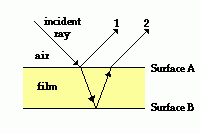
Reflected waves undergo a 180 degree phase shift when and no phase shift when reflecting from a medium of lower index of refraction ().
The Size of a Diffracting Aperture
When light from a point source passes through a small circular aperture, it does not produce a bright dot as an image, but rather as a diffused circular disc.
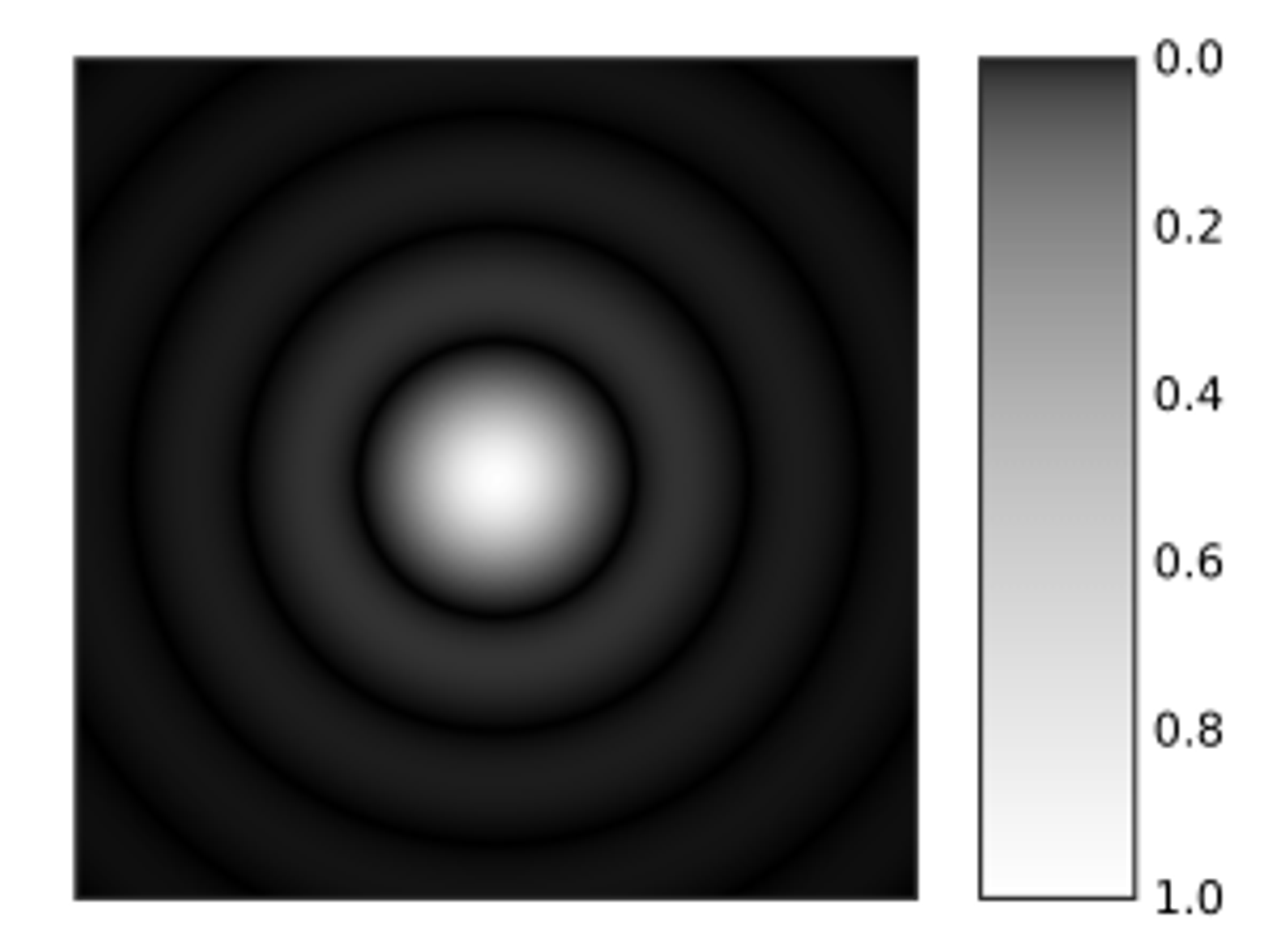 The greater the diameter of the diffracting aperture (such as the diameter of the pupil in the human eye or the diameter of the lens in a telescope), the better resolved (clearer) the image is.
The Resolution of Simple Monochromatic Two-Source Systems
Consider the diffraction pattern of two light beams diffracted by a single slit. These patterns can be categorized as resolved, just resolved, or not resolved depending on the separation between the images.
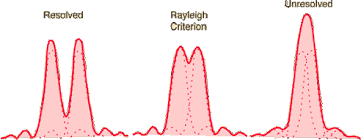
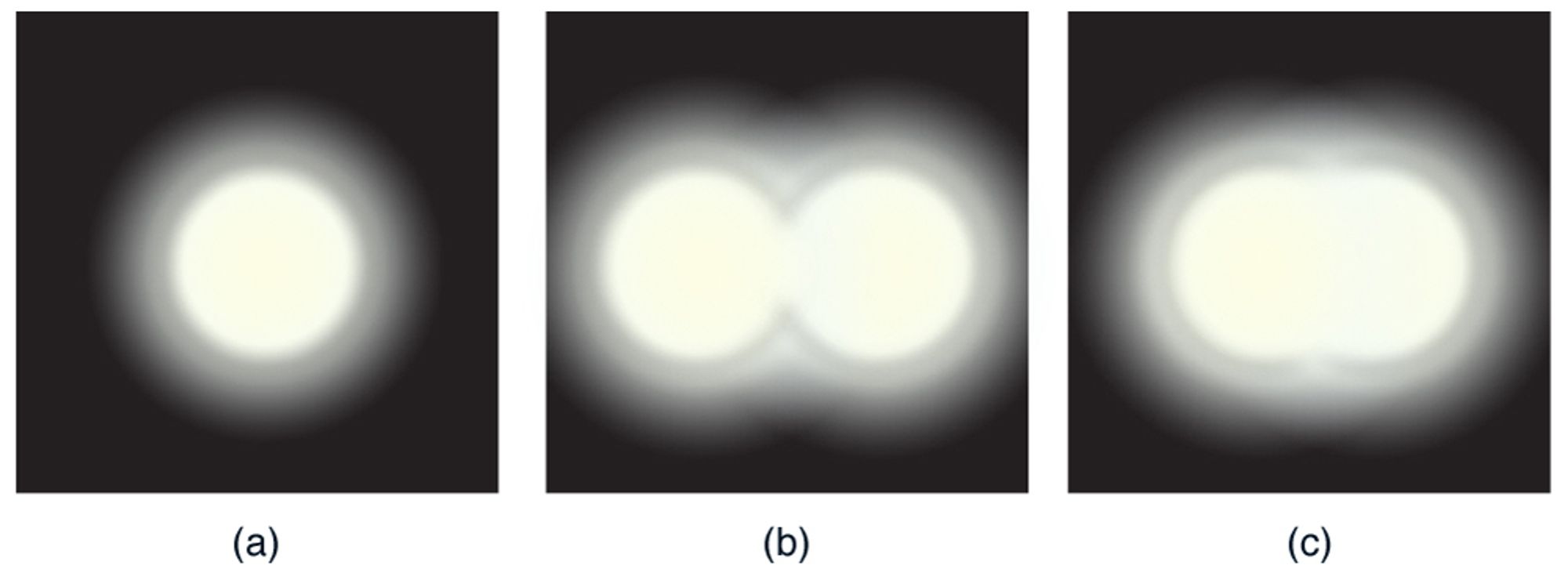
The Rayleigh criterion is when two points are just resolved. This is when the central maximum of one image coincides with the first minimum of the other.
The minimum angular separation θ (in radians) for two points to be just resolved is given by Where is the diameter of the circular aperture, and λ is the wavelength and a is the diameter of the circular aperture lens receiving the image
In resolution technology:
- CDs and DVDs: By using laser beams with shorter wavelength, we can improve resolving power of the laser and increase the amount of data stored on the discs.
- Electron microscope: Short wavelength of electrons allows electron microscopes to create images with very high resolution.
- Radio telescopes: Radio waves have long wavelengths, so the aperture (satellite dish) needs to be very large for a radio telescope to achieve good resolution.
Polarization
Light sources often emit several wavelengths of light and at different orientations. Light that consists of the same wavelength is monochromatic, and if multiple light waves have the same wavelength (and are produced at the same time) they are coherent. A laser is coherent. If there are multiple wavelengths and or produced at random moments in time, the resulting light is incoherent. A lightbulb is a common example of incoherent light.
Linearly polarized light has waves that have their electric (and thus perpendicular magnetic) field components vibrating in the same place. It is formed by passing unpolarized light through a polarizer, which only allows light to pass through if it is in a specific orientation. As light is a transverse wave (polarization only occur to transverse waves), light is plane polarized if the electric field oscillates in one plane.
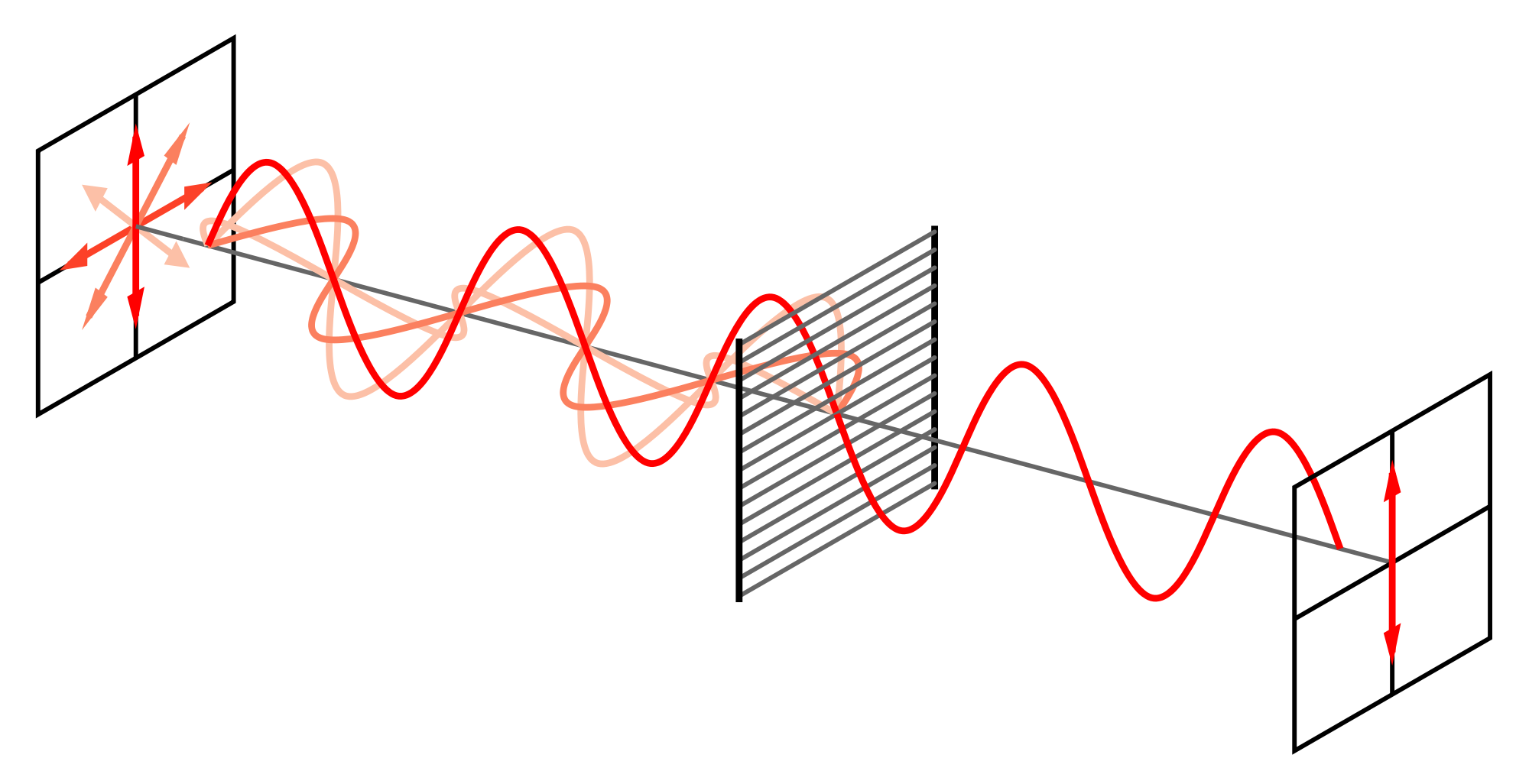
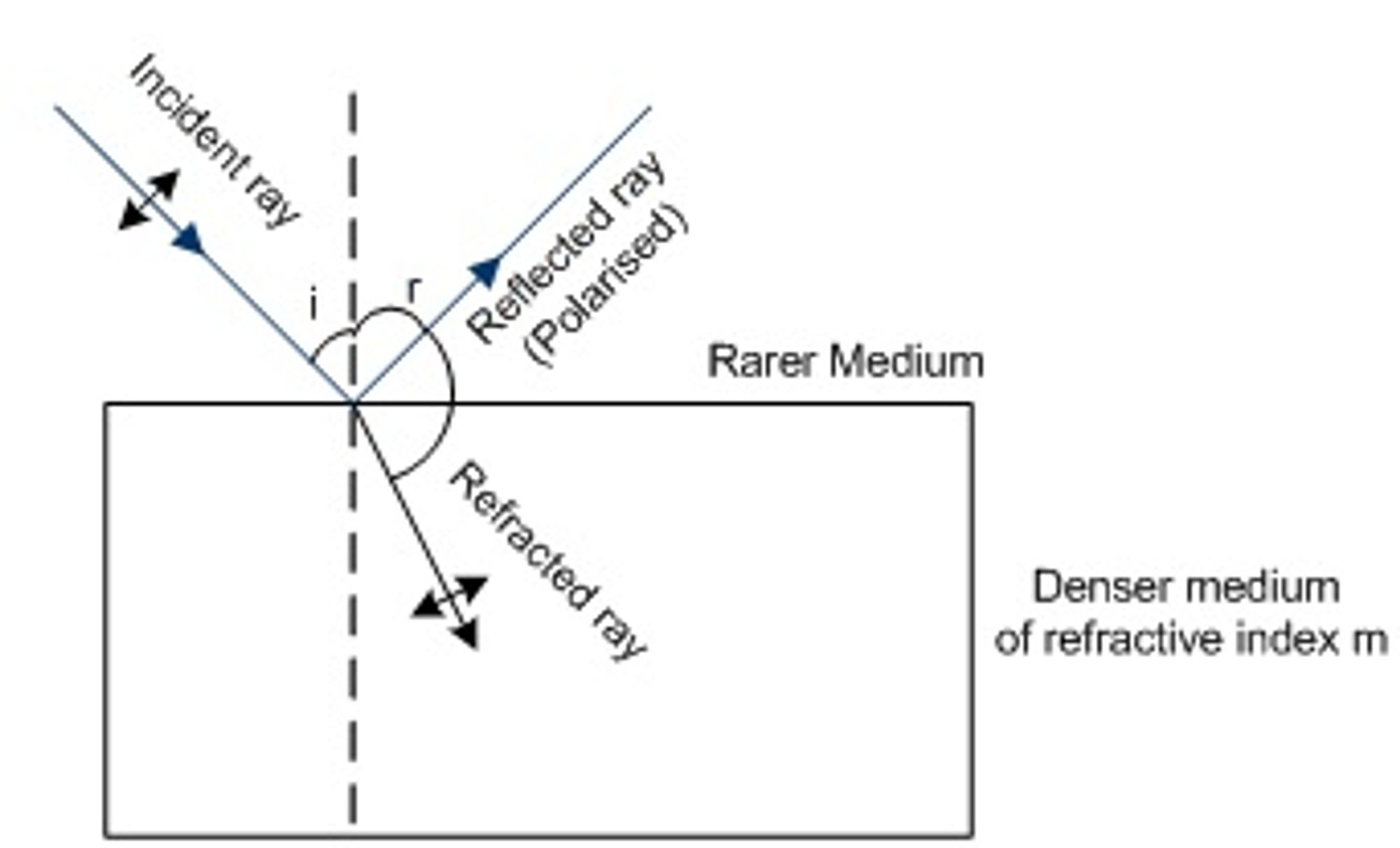
Left shows unpolarized light and right shows polarized light. Polarization by reflection When light is transmitted across a boundary between two mediums with different refractive indexes, part of the light is reflected and the remaining part is refracted (for further explanation, see section 4.4). The light reflected is partially polarized, meaning that it is a mixture of polarized light and unpolarized light. The extent to which the reflected light is polarized depends on the angle of incidence and the refractive index of the two mediums. The angle of incidence at which the reflected light is totally polarized is called the Brewster’s angle (ϕ) given by the equation.
Where n1 and n2 are the refractive indexes for their respective mediums
When the angle of incidence is equal to Brewster’s angle, the reflected ray is totally polarized and the reflected ray is perpendicular to the refracted ray.
Polarizer:
- A polarizer is a sheet of material which polarizes light.
- When unpolarized light passes through a polarizer, its intensity is reduced by 50%.
Analyzer:
- When polarized light passes through a polarizer, its intensity will be reduced by a factor dependent on the orientation of the polarizer. This property allows us to deduce the polarization of light by using a polarizer.
- A polarizer used for this purpose is called an analyzer.
Malus’ Law relates the incident intensity and transmitted intensity of light passing through a polarizer and an analyzer.

Where I is the transmitted intensity, I0 is the initial light intensity upon the analyzer, θ is the angle between the transmission axis and the analyzer.
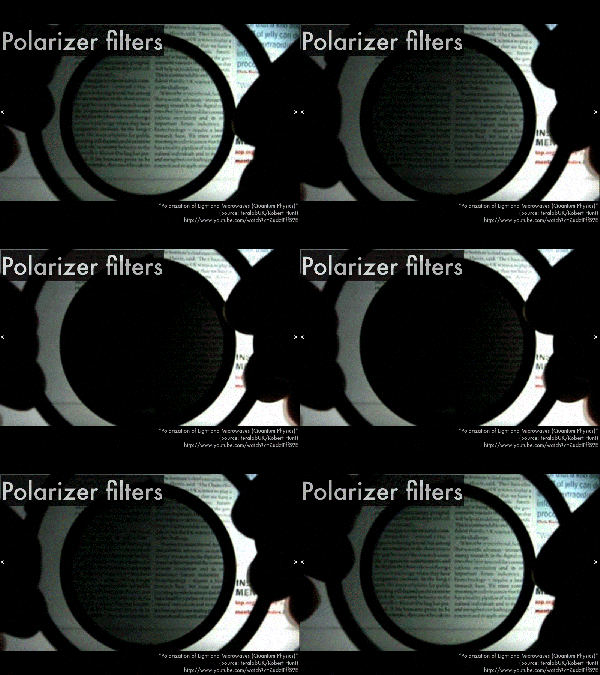
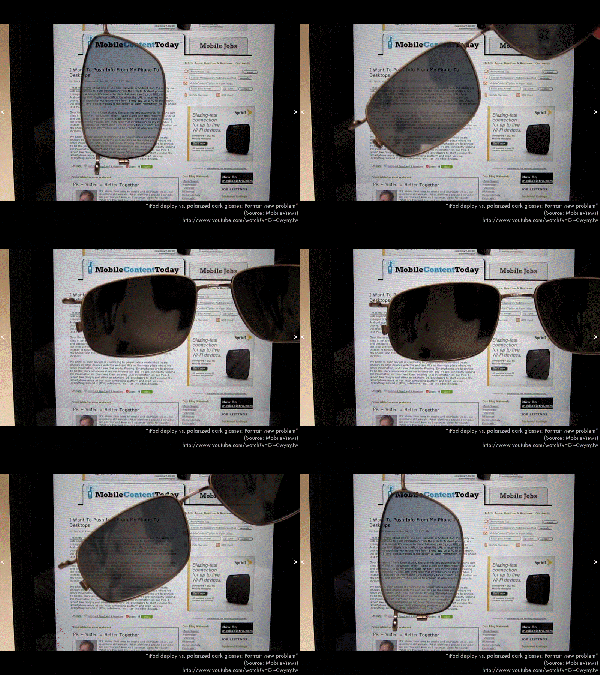
When light passes through an optically active substance, the plane of polarization rotates.
Wave-Particle Duality of Light
In the Compton effect, it is observed that an electron that “collides” with a photon is redirected with some velocity similar to a billiard ball and other particles. This would imply that light (photon particle) behaves as a particle.
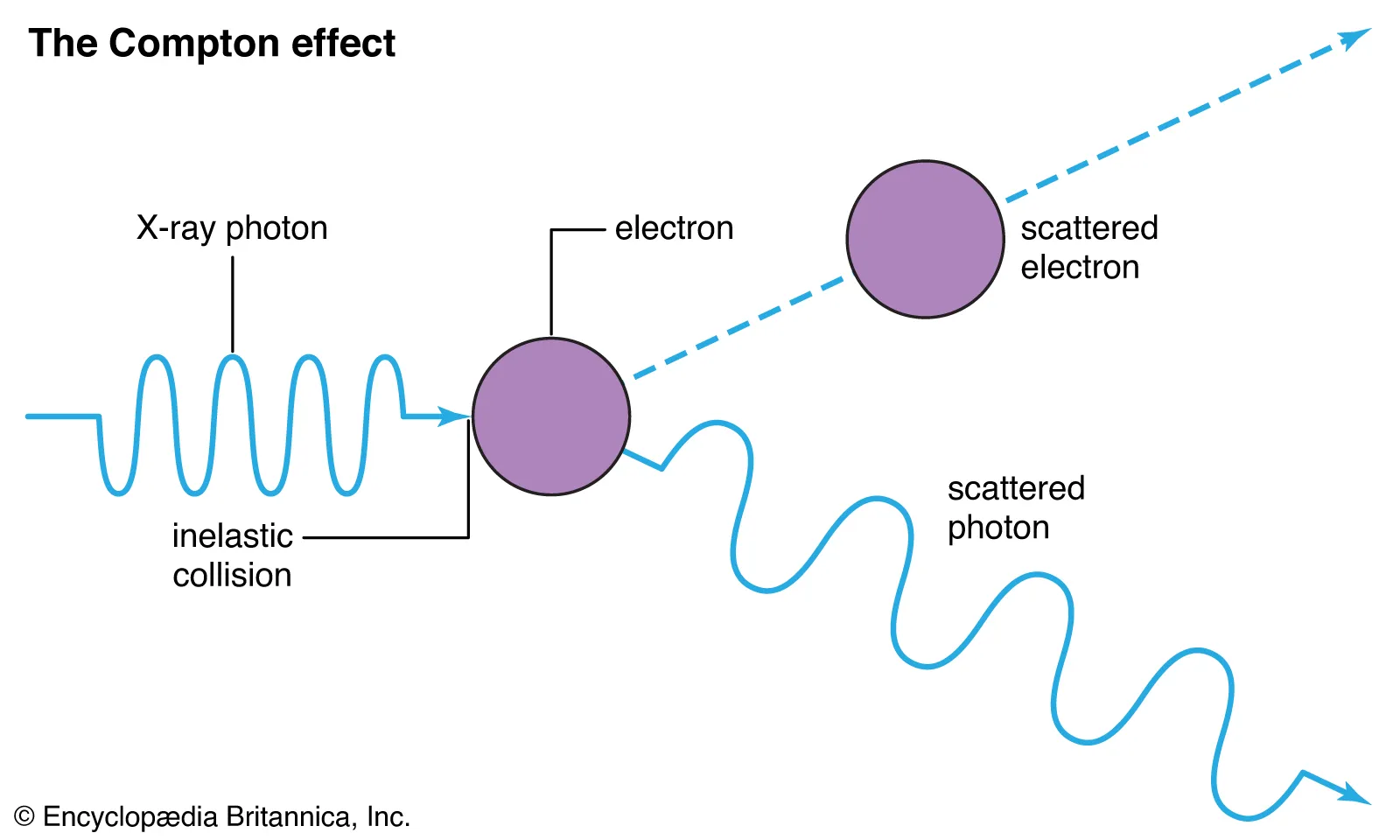
Photons have particle like behavior such as carrying a specific amount of energy and momentum, but not like typical particles as they are massless. They can also be easily annihilated and created when they interact with matter. The energy of a photon is directly proportional to its frequency and inversely proportional to its wavelength: Where is Planck’s constant .
Photoelectric Effect
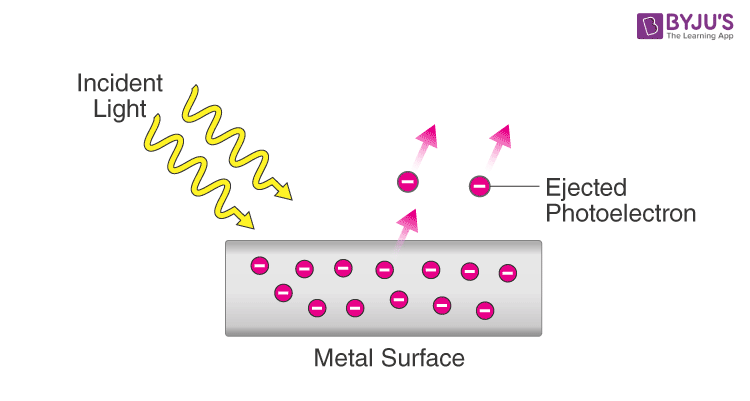
When light is incident on a solid substance, electrons may be ejected. This phenomenon is called the photoelectric effect, and appears the basis of the frequency of the light that is incident. Where the incident light has the energy .
On a plot of the kinetic energy of the electron vs the frequency of the light there is some threshold frequency at which electrons begin to be emitted.
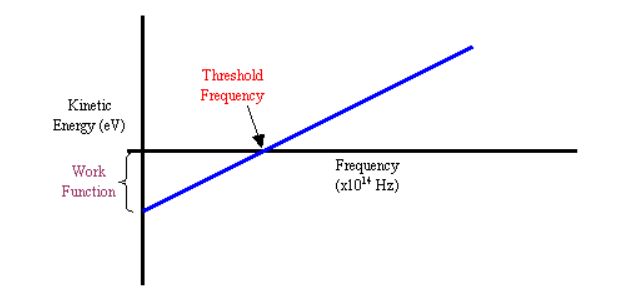
The kinetic energy of the ejected electrons originated from the energy of the incident light . As some energy is consumed in removing the electron from the surface (work function) , the kinetic energy of the ejected electron is calculated using the conservation of energy:
E_{light} = E_{binding} + E_k \\ E_k = E_{light}- E_{binding} \\ E_k = h(f-f_0) \end{gather}$$ Where $f_0$ is the threshold frequency. More intense light = more electrons, higher energy electrons = faster travelling electrons. The only logical explanation for the photoelectric effect is that there must be particles of energy that give their entire energy to an electron in the metal. ## [[Atomic structure#evidence-for-the-bohr-model-line-spectra|Evidence for the Bohr model Line spectra]]