2024-10-0411:05 Status:PHYS106 Tags:
Mechanical equilibrium occurs when velocities are zero and forces add to zero for each part of a physical system. Or
Restoring Forces:
For a (stable) equilibrium configuration, a displacement in one direction leads to a net force in the other direction.
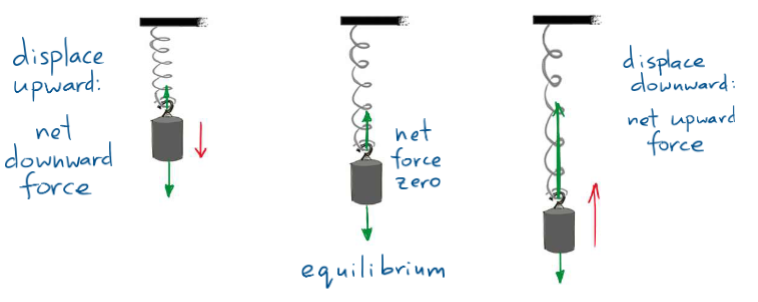
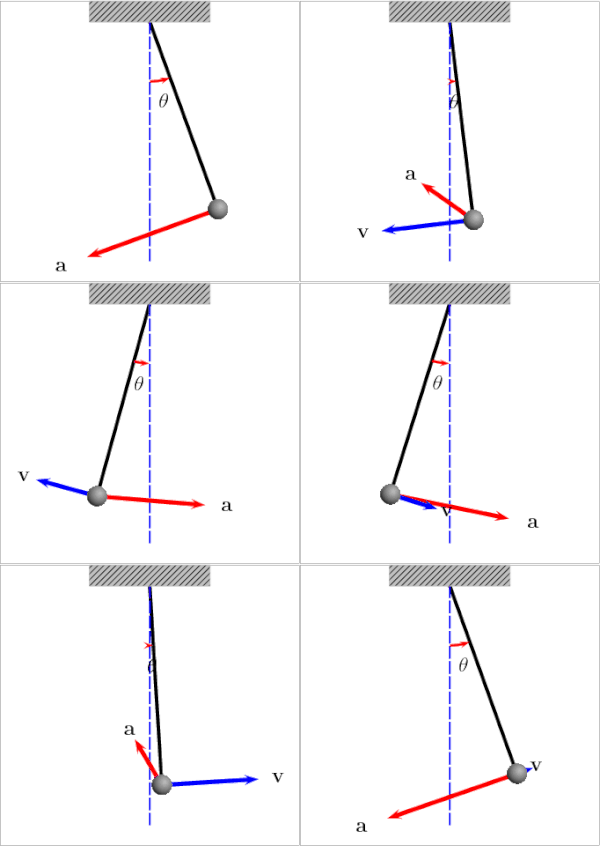
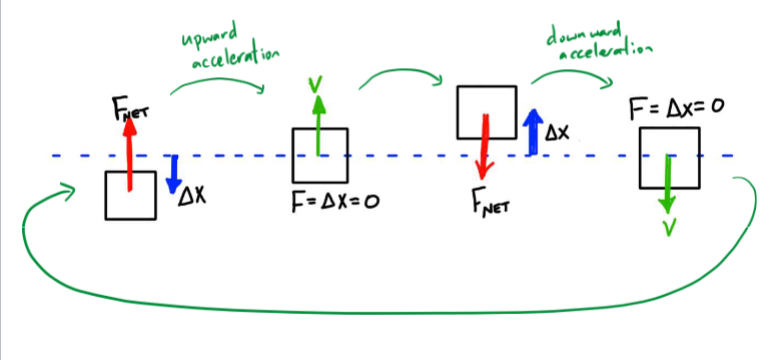
Oscillations
The restoring forces decay to 0 as an object comes to the equilibrium position. For instance, when a book is placed on a table, it makes a sound - this is the result of several oscillations happening within a fraction of a second.
Net Force vs. Displacement Graph + Hooke’s Law
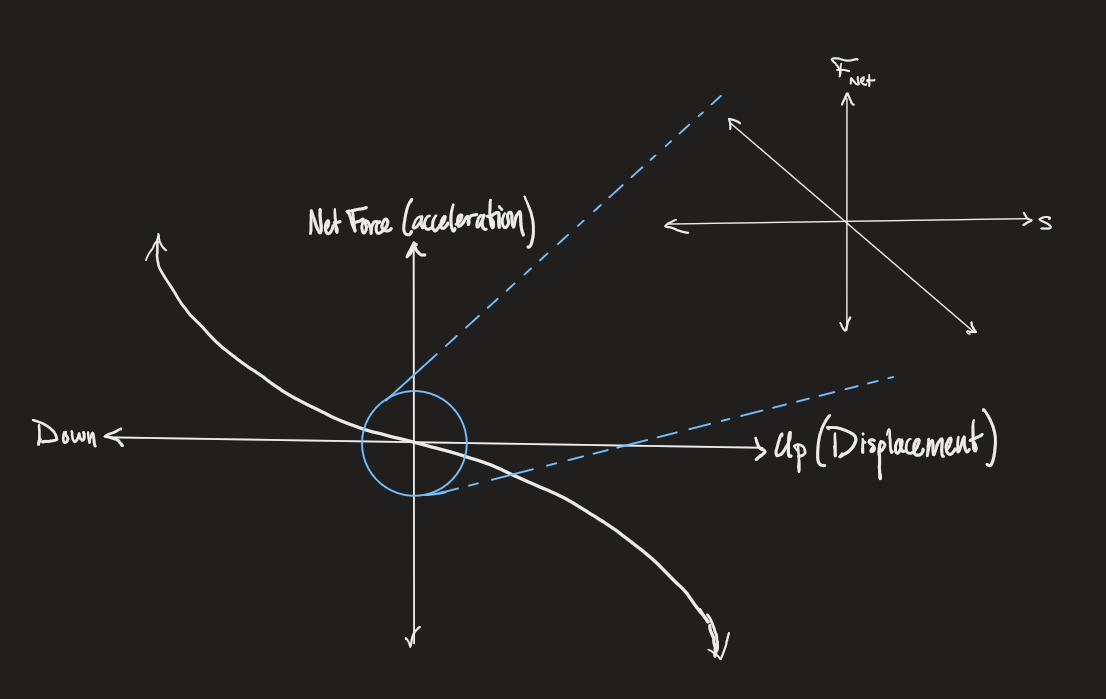 Where the zoomed in version approaches a linear approximation for which Hooke’s Law applies.
Hooke’s Law: Applies to almost any system perturbed a small amount from its stable equilibrium: Where is a “spring/restoring” constant and is displacement.
This is exact for an ideal spring.
Oscillations with Hooke’s Law
Newton found:
Thus we can find how velocity and position change with time.
The solution is: